
Flutter for MVP Development in 2026: Launch Fast, Learn Faster, Scale Smart
Paresh Mayani
Dec 1, 2025
Share Article


Every product starts with a hypothesis, an assumption waiting to get tested. In today’s competitive market, waiting for months to validate an idea is a difficult task that most startups usually need.
Over 90% of startups fail just because they build too much before learning what users actually want.
That’s why in 2026, today’s founders are moving towards Flutter for MVP application development to build fast, validate faster, and scale without limits.
Higher scalability, cross-platform reach, and native performance are what you get when using Flutter. It provides startups the competitive edge they need to expand, attract investors, and deploy early before the competitors do.
In this blog, we’ll explore why Flutter is the prominent option for MVP development in 2026, its key benefits, step-by-step build process, and expert tips to scale fast.
Why Start with an MVP?
Before we explore Flutter, first, let's see what an MVP is and why it is crucial for startups.
An MVP (minimum viable product) is the simplest version of your product that solves the core user problem and allows you to collect feedback.
For startups, building an MVP helps:
- Validate the idea before full investment.
- Launch faster to market, beat competition.
- Save costs by focusing only on core features.
In 2026, with markets saturated and user expectations rising, and is has become essential to keep up and solve user pain points with faster collection of feedback. Creating a minimum viable product (MVP) using Flutter enable startups to test ideas across multiple platforms.
Why Use Flutter for MVP Development?
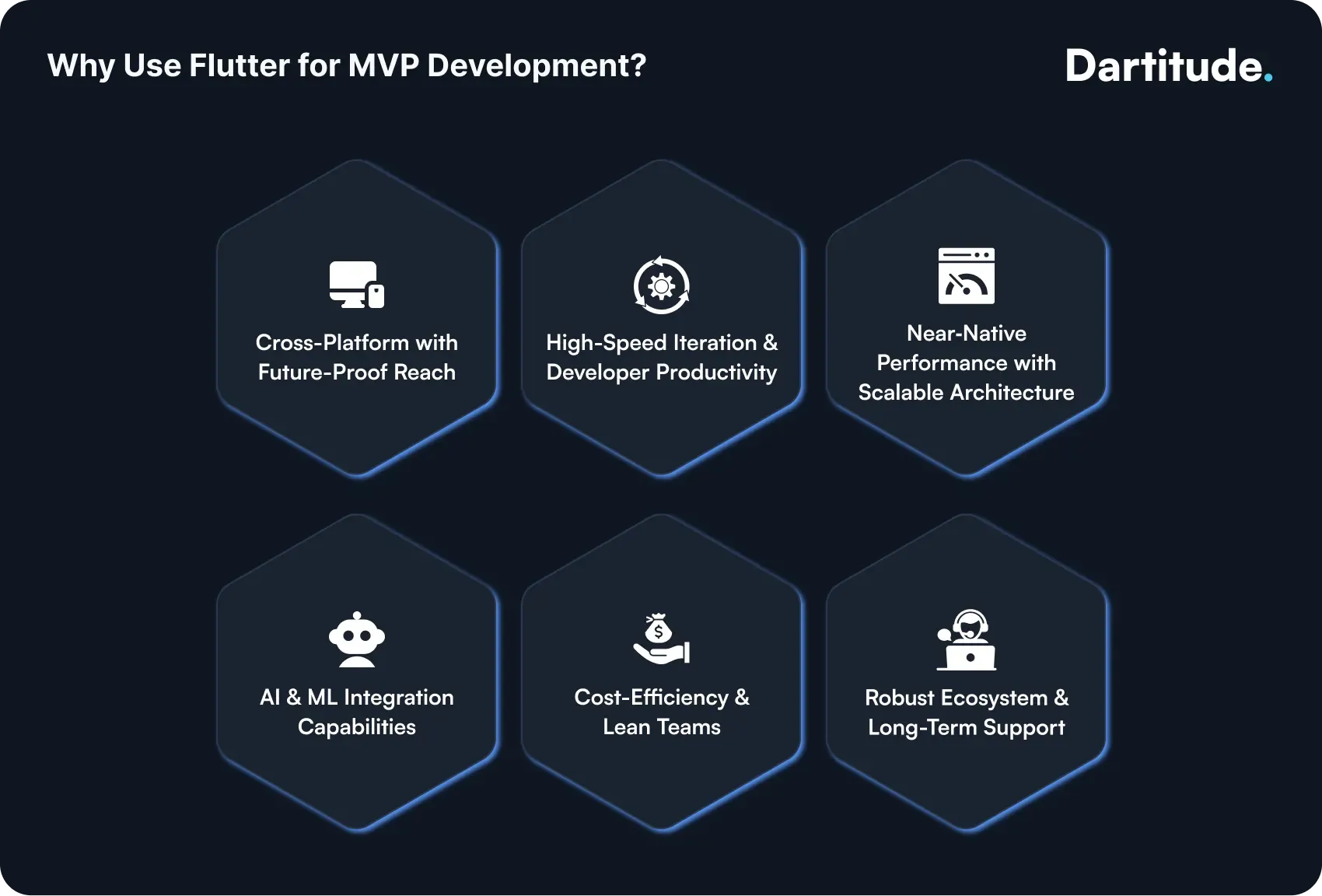
There are many developers who are still unaware of why Flutter is the top choice for MVP development, especially when speed, scalability, and cross-platform reach are necessary for startups in 2026.
Below points explain why using Flutter and engaging professional Flutter app development services can enhance your product journey:
1. Cross-Platform with Future-Proof Reach
In 2026, Flutter is not only for mobile, but it also supports desktop, web, and all is also done from a single Dart codebase. It is mostly preferred for a startup. With MVP, you can validate the idea on different platforms without rewriting code or hiring additional teams.
2. High-Speed Iteration & Developer Productivity
No doubt Flutter’s hot reload is an advantage, but Dart DevTools have been improved in 2026 with better debugging and promotion and performance level. This allows developers to prototype and refine features faster, enabling lean MVP cycles.
3. Near‑Native Performance with Scalable Architecture
Flutter can now deliver fast and smooth performance, all due to its ARM Code and Skia engine. This is important for MVPs because users don’t like lagging and slow apps. The architecture of Flutter supports new features without major rewritten of code.
4. AI & ML Integration Capabilities
Yes, with growing demand and a larger community of Flutter, its ecosystem can now support AI-driven features, and many startups are now getting integrated with models or using AI generative models that use Flutter + Firebase and more.
Read more: Boost Your Apps with Flutter AI Integration
5. Cost-Efficiency & Lean Teams
By the use of a single development team, you can build apps on multiple platforms, thus reducing cost. Also, a few codebases to maintain and a unified testing setup are cheaper, saving resources for startups.
6. Robust Ecosystem & Long-Term Support
As everyone is aware that Flutter is supported by Google, it has a massive and active community, with thousands of packages. In 2026, it is easy to integrate with backend services such as Firebase, analytics, and AI payments, expanding your MVP into a complete digital product.
Remember: Want to build smart and fast? Flutter allows you to launch 3× quicker and saves nearly 40% of coding effort, while Flutter guarantees higher scalability, enabling you to focus on understanding what your users truly need.
Flutter MVP Development Trends to Watch in 2026
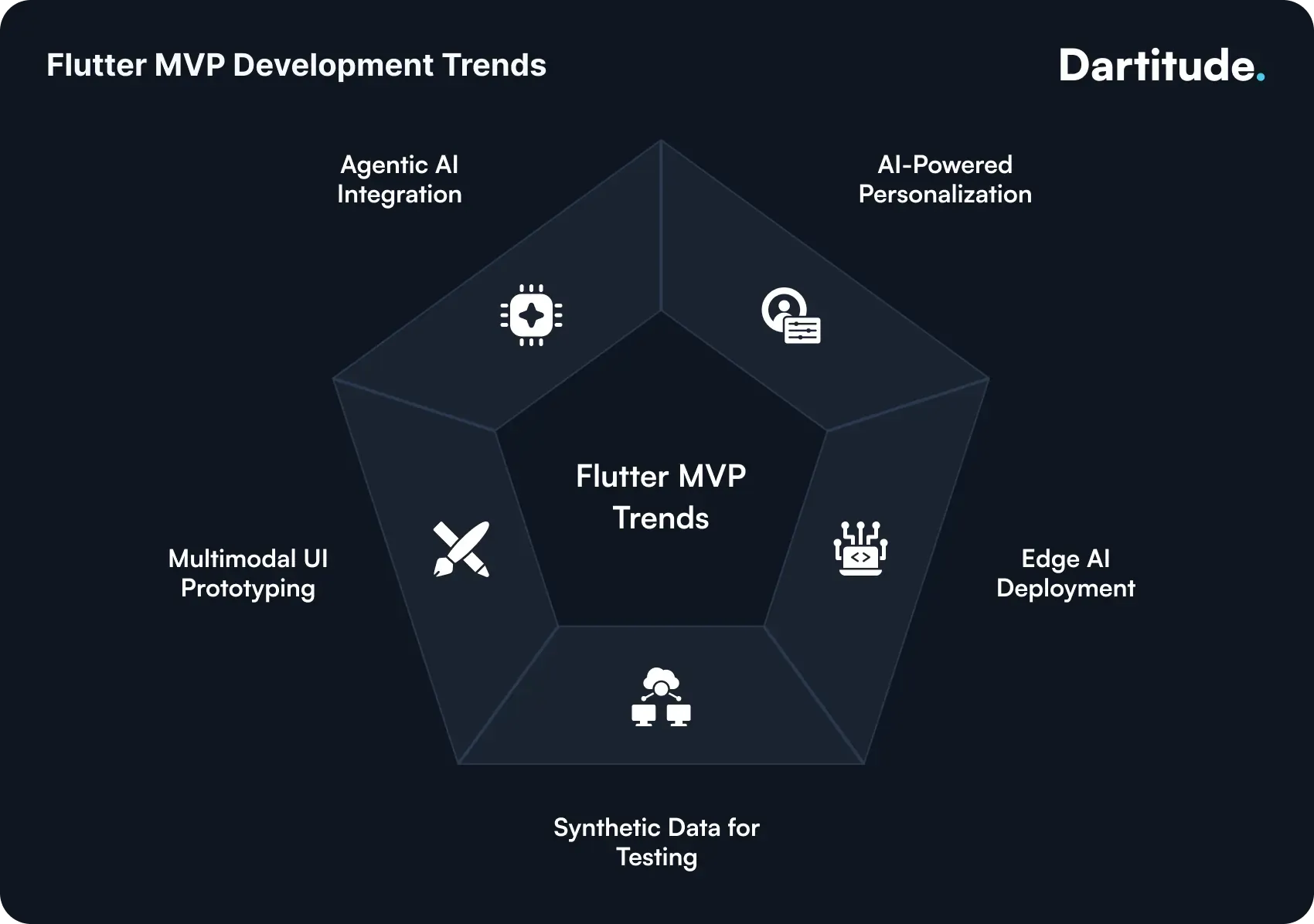
Flutter MVP development is changing with AI and next-gen technologies to improve validation, improve user experience, and boost startup success.
Here are the latest Flutter MVP development trends in 2026:
1. Agentic AI Integration
For optimizing user flow dynamically, autonomous AI agents are increasingly used in Flutter MVPs. Startups using these agents have 30% faster development cycles as improvements are being suggested by AI, and manual intervention is avoided.
2. Multimodal UI Prototyping
Next-gen MVPs combine text, voice and images to create immersive interfaces in Flutter. This method boosts user engagement, with early studies showing 25–40% higher interaction rates in multimodal prototypes compared to traditional UI.
3. Synthetic Data for Testing
Synthetic data refers to artificially generated data that provides you with fake statistical properties and structure of real-world data, used to test an application's functionality without using sensitive or real information. It helps test MVP without using real information.
4. Edge AI Deployment
AI-powered features are now being embedded with the Flutter MVPs and directly on the device, for offline performance and global access. With the deployment of edge AI, it critically reduces the dependency on cloud infrastructure, improving user experience in different regions with lower connectivity.
5. AI-Powered Personalization
Through AI-powered personalization, you are able to get adjusted content, recommendations and interfaces tailored to user behavior. Startups integrating AI personalization have observed 25–35% higher retention rates, making MVPs more effective in early market validation.
Key Benefits of Building Your MVP with Flutter
Building an MVP with Flutter offers several advantages for startups. Here are the key benefits to build an MVP using this framework:
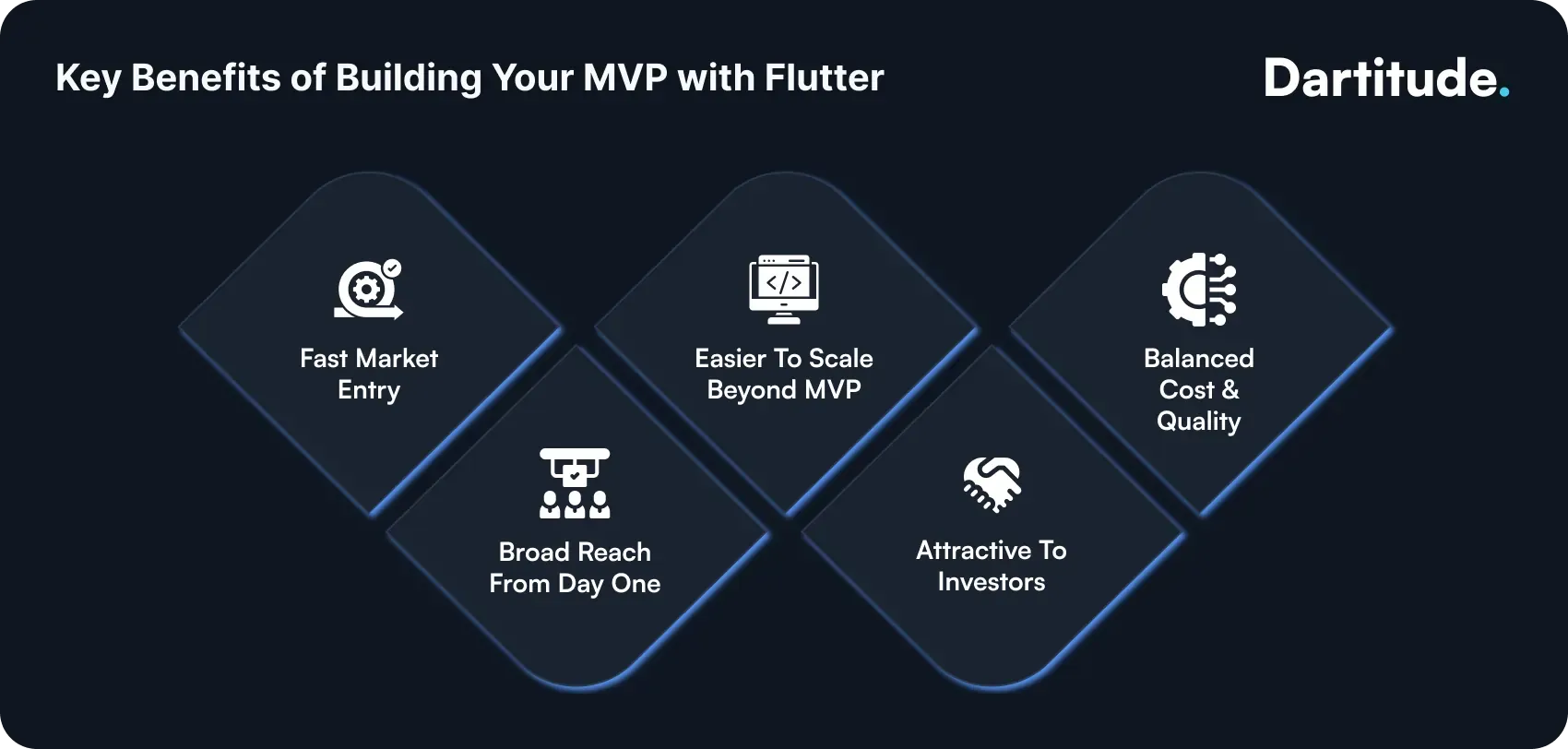
1. Fast market entry
With the help of Flutter, you can shorten or reduce the build phase timeline and boost the MVP launch. You can build essential features, collect feedback and do testing in less time
2. Broad reach from day one
Yes, Flutter allows you to build cross-platform apps for both iOS and Android. You can reach users widely with less additional work. Most beneficial for startups, as they can get a potential user base for feedback and validation.
3. Easier to scale beyond MVP
After the validation of your MVP, you would like to add more features, refine UX, and handle users. All this can be achieved by integrating with Flutter architecture, which enables you to expand into platforms and features.
4. Attractive to investors
If you want to attract more investors, it is important that you have a working prototype of an MVP that performs well. Many Flutter app development companies provide this offer at affordable prices.
5. Balanced cost and quality
With Flutter enabled, your quality of MVP won't be compromised. It is because Flutter is not a cheap solution; instead, it provides you with near native few resources. This makes the MVP succeed in a very balanced way.
Common Flutter Pitfalls and How to Avoid Them
Yes, building an MVP has risks, even if built with Flutter. Let’s cover a few and how to mitigate them, mainly ones trending for 2026.
| Common Pitfall | Description | Tip to Avoid |
| Over-building the MVP | Overbuilding means building too much of your MVP. Only solve one core user problem, not every feature. | Prioritize features with a must-have vs nice-to-have list. |
| Ignoring platform-specific nuance | Flutter is cross-platform, but users expect native-like behavior on iOS vs Android. | Use platform-aware widgets and test on real devices. |
| Under-estimating backend & scalability | Focusing only on the frontend can create issues when scaling. MVPs need a backend that grows with the product. | Select a strong backend architecture that supports iteration, analytics, and growth. |
| Choosing plugins without validation | Not every Flutter package is mature or maintained. Using unreliable plugins can slow down the process. | Check plugin health in 2026, last update, community usage, and support before integrating |
| File size and platform-specific features | Flutter apps can have larger APK/IPA sizes; some native APIs may require bridging. | Monitor app size, remove unused assets. |
Insight: Flutter MVP failures in 2026 are rarely due to UI, and most problems come from feature overload and backend scalability gaps. Teams that validate early and build backend can reduce rebuild costs by 50%+ later.
How to Build an MVP with Flutter: Step-by-Step Process for 2026
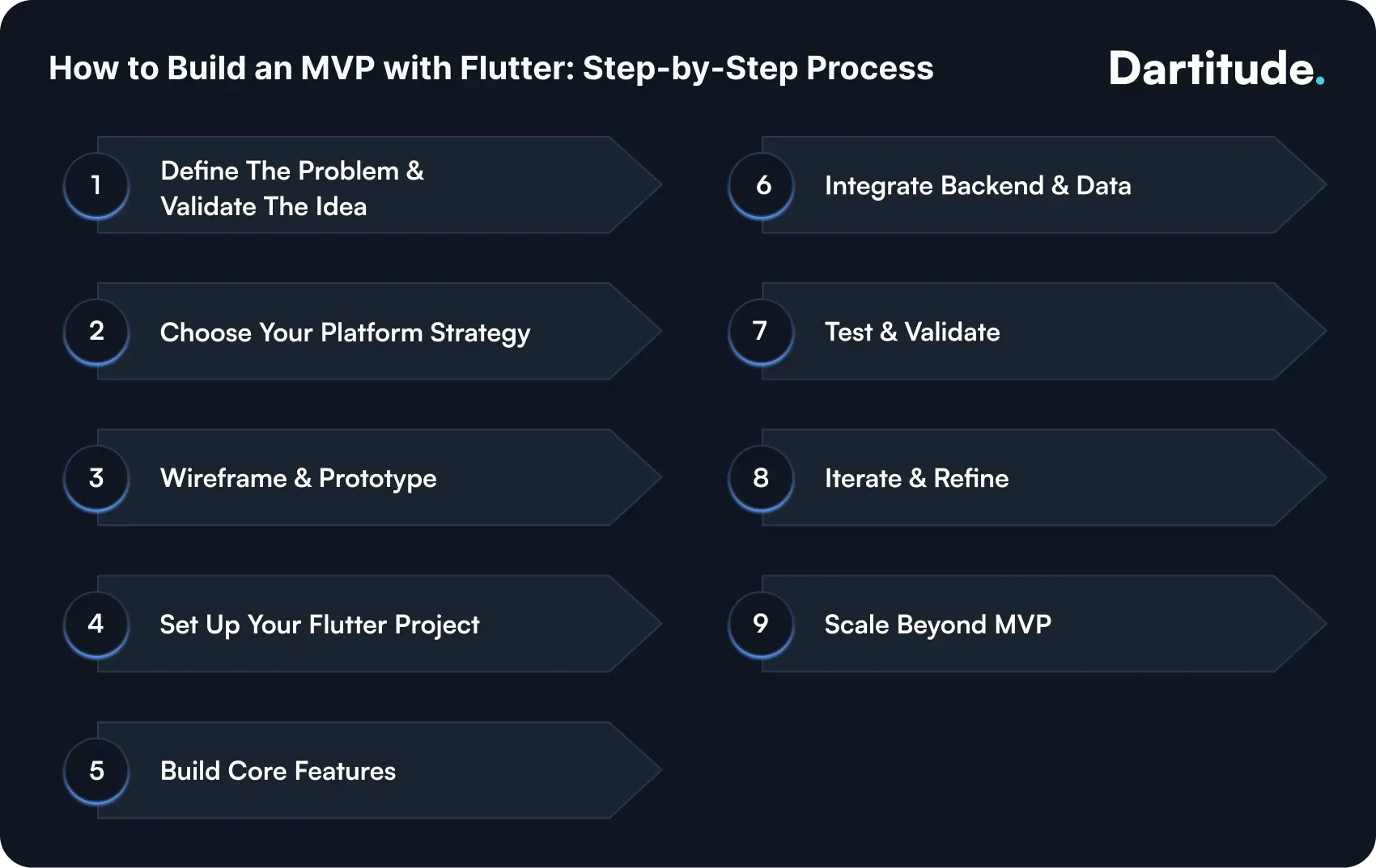
Do you know how you can build an MVP with Flutter? If not, here’s the detailed breakdown of the step-by-step guide for 2026 that needs to be taken into consideration:
1. Define the problem & validate the idea
You need to define the core problem and identify the user pain that you are trying to solve, and for whom you are building the MVP. To do this, create a simple landing page or mockup to test interest instead of building early.
2. Choose your platform strategy
It is essential to decide whether your MVP should be launched on mobile or web, and align with 2026 expectations. If you're planning Flutter for MVP application development, cross-platform becomes an advantage from the start.
3. Wireframe & prototype
For wireframing and prototyping, you can use Figma or Adobe XD to see screen scalability and the user journey from login to actual functionality. This will help in checking out a complete UI and UX journey of an MVP.
4. Set up your Flutter project
Setting up a Flutter project is essential. Choose a scalable state management solution, for example, Riverpod, Bloc, depending on future needs. Structure your project for maintainability and integrate packages selectively in the correct way.
5. Build core features
You need to see what core features are required to build and integrate within your MVP. Initiate with authentication and a single core action that solves the user's main problem. Add lightweight analytics and feedback collection to support early learning loops.
6. Integrate backend & data
Choose and build a strong backend early stage. For scalability, you can use Firebase, AWS Amplify or a custom modular API, depending on the product roadmap. Implement core storage, user management and notifications only if they directly support the MVP purpose.
7. Test & validate
Make sure to release MVP early adapters or beta testers to collect user signals, not only opinions. Track feedback, engagement patterns and friction points to analyze what users value most.
8. Iterate & refine
Focus on making improvements based on user experience instead of assumptions. Fix bottlenecks, adjust UX and add only the features that show clear value. Each iteration should reduce friction and enhance retention until the product consistently solves the problem.
9. Scale beyond MVP
Once the product is validated, expand features, refine architecture and support additional platforms such as web and desktop. A well-designed Flutter codebase can boost multi-platform growth without a full rebuild. This stage is where you might need to hire Flutter developer experts to optimize scaling and long-term architecture.
Key Note: Flutter boosts the development speed, but problem clarity, scope control, and continuous user feedback determine whether the MVP evolves into a successful full-scale product.
What to Look for in a Flutter MVP Development Partner?
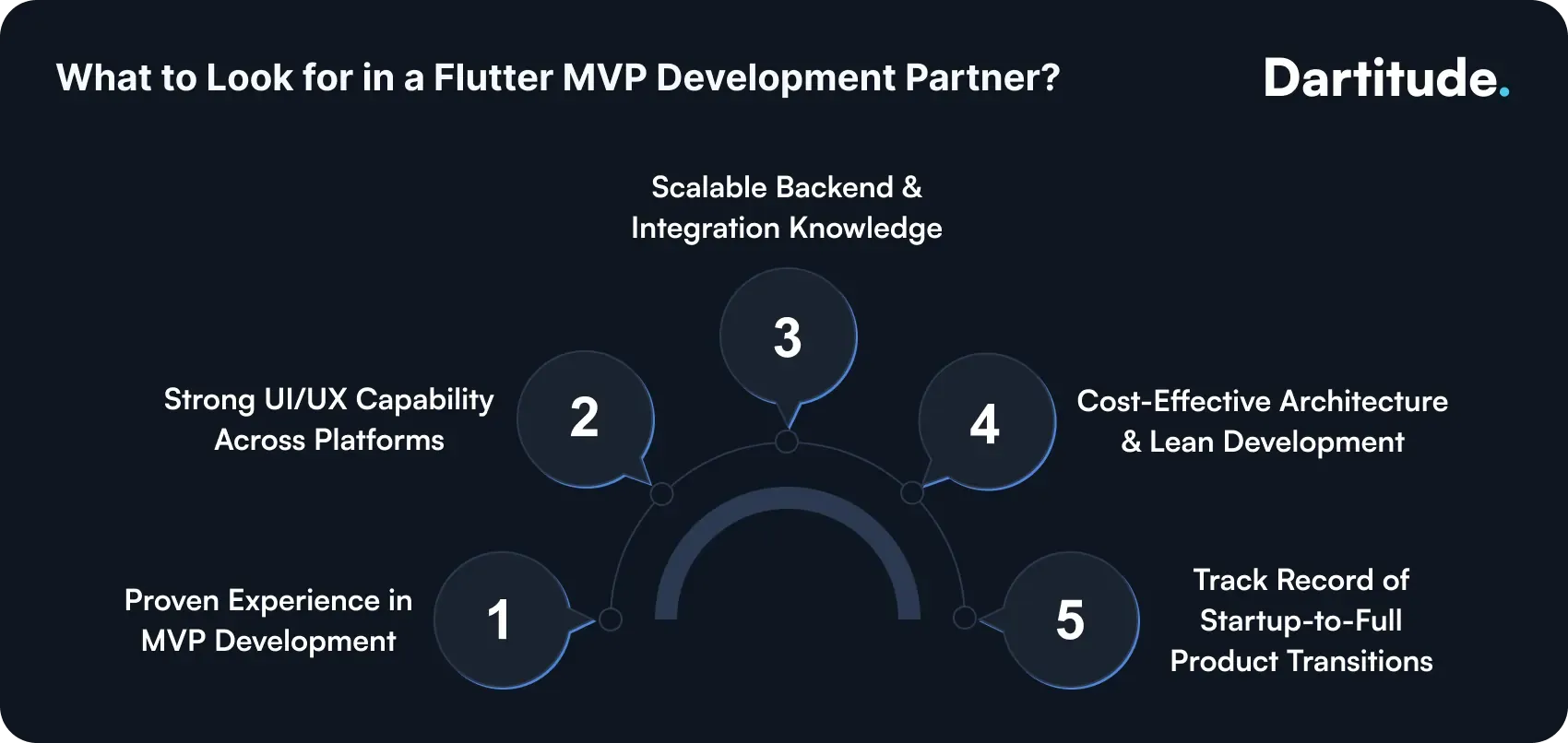
Struggling to find the right MVP development partner? Below are critical factors you need to check before hiring a Flutter MVP development partner:
1. Proven Experience in MVP Development
Select a partner with a strong, proven record of building MVPs, mainly with Flutter and especially using the cross-platform app development framework. Only those experienced in full-scale apps won't work; they should know the process of rapid validation, iteration and core development.
2. Strong UI/UX Capability Across Platforms
Yes, that's the core. Check whether the partner you are planning to choose has a strong UI/UX capability across different platforms or not. Startups aiming for Cross-platform app development benefit from teams that can design and optimize user interfaces for all platforms efficiently.
3. Scalable Backend & Integration Knowledge
The right partner needs to know about backend and integration, analyzing how to design a backend that scales with your product. Proper integration with databases, APIs, and cloud services ensures your MVP can expand efficiently as demand rises.
4. Cost-Effective Architecture & Lean Development
The cost factor and development directly affect the success of your MVP. Lean startups need partners who can optimize resources without compromising quality. A cost-conscious development process helps in the deployment of an MVP quickly, staying within budget.
5. Track Record of Startup-to-Full Product Transitions
Check out their portfolio, client testimonials, and ensure the teams that you are choosing have successfully worked on MVPs and with startups to complete digitalized products.

Final Verdict: Flutter Is the Fast Lane for Startup MVPs
In 2026, startups that adopt Flutter for MVP development get a prior advantage of launching faster, validating quickly, and expanding without technical issues. Flutter provides you with cross-platform reach, near-native performance, and modern AI readiness for long-term product success.
The real variance is not in coding alone, but speed of learning, teams that build lean, understand users, and iterate early outperform.
Looking to turn MVP into a high-impact digital product? Dartitude Labs could transform the journey from MVP to full-scale app using Flutter for MVP development.
With scalable architecture, lean engineering, and user-centric design, they help startups grow fast and deploy the product quickly.
FAQs
1. Is Flutter a smart choice for MVP development in 2026?
Yes, Flutter is a smart choice for MVP in 2026. It is because it provides you with speed launch cycles across cross platforms from a single codebase and unified platform. Startups using Flutter recorded 2x faster deployment contrast to native development.
2. Can a Flutter MVP scale into a full product later?
You can scale the Flutter MVP into a full product later with well well-structured MVP. Teams can expand traffic capacity and the latest features on the same codebase instead of writing code from scratch.
3. Is Flutter more cost-effective than building separate native apps?
Yes, Flutter is more cost-effective when compared to building separate native apps. You can work with a single team, and startups can save up to 3-40% MVP development costs.
4. Does Flutter support AI-powered or GenAI-based applications?
Definitely, it does. Flutter does support AAI-powered and GenAI-based applications and has been updating its features with time. Flutters ecosystem in 2026 includes seamless integration with GenAI models, Firebase AI, Whisper and more. Apps could easily add AI chat, voice and image processing with fewer errors or minimal lag.
5. Does using Flutter help with investor readiness and pitching?
It has been observed that teams using Flutter for MVP development have seen 3× higher investor interest because live prototypes communicate traction and quick execution of the product.


