

What Is State Management in Flutter & Which One Should You Use?
Nov 24, 2025
Share Article


Most Flutter apps don’t fail because of bad UI; they fail because of bad state management.
I remember a telemedicine client calling in a hurry: The patient updated their health status in the app, but the doctor’s screen didn’t refresh, and everything got frozen.
When we explored the issue wasn’t the API or UI. It was state management, the root cause of 60% Flutter performance problems.
That’s when it was all clear.
Selecting the wrong state management approach can break your app, no matter how good your UI looks.
What is a State?
State is any data that reflects the current behavior of an application. It includes credentials such as object lists obtained from the server, the name of the current logged-in user, and more. Understanding this is the foundation of how to manage state in Flutter, as these values frequently change while the user engages with the app.
What is State Management in Flutter?
State management in Flutter is defined as a way you manage and structure your data that controls your app's UI behavior.
The state in the app changes as per the user's input and uses the app, and based on events, specifically for developers.
The state is like a memory of your application. When a user adds an item to their cart or logs in, your app's state changes.
Let's dig in and see what state management is and why it matters.
Why State Management Matters so Much in Flutter
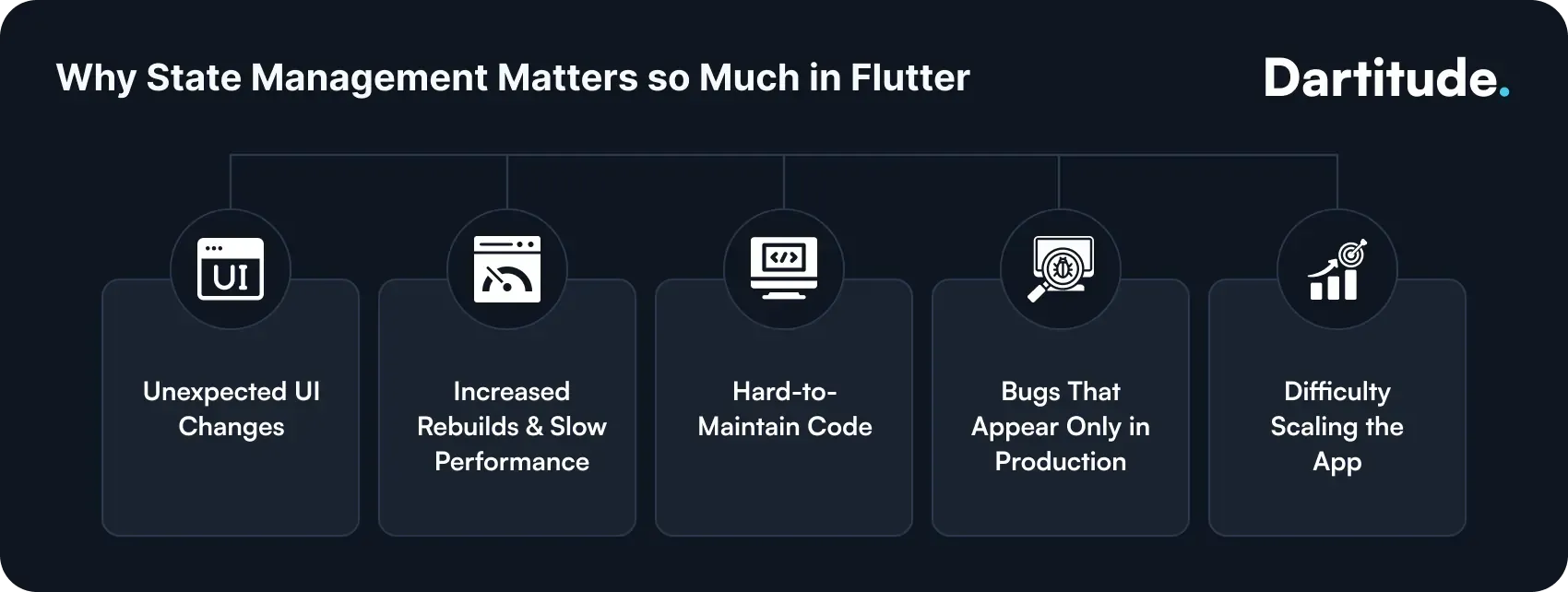
Yes, state management plays a crucial role in Flutter. It is because Flutter builds apps that rebuild UI based on changing state. Pick any Flutter app development company, and it will tell you that a poorly managed state is one of the top reasons apps become slow, unstable, or hard to scale. Poorly managed state leads to:
1. Unexpected UI Changes
If the state is not properly controlled, chances of getting UI updates at the wrong time or in the wrong place can confuse users. This also breaks trust of users if apps make such mistakes that can create a bad experience for the users.
2. Increased Rebuilds and Slow Performance
Widgets are being rebuilt by futter aggressively, and also poor state management triggers irrelevant rebuilds. This further results in slow screen and poor UI. So make sure to avoid rebuilds.
3. Hard-to-Maintain Code
It is difficult for the developers to maintain the line of code in the correct format. Divided state logic can lead to simplified updates into complicated time time-consuming debugging. Many of the developers waste their time seeing where the changes have been made. This results in slowing down performance velocity and increases the additional costs.
4. Bugs That Appear Only in Production
There are many hidden bugs, inconsistent updates that are not shown during the testing process. But once the users actually use the system, these bugs are exposed, and this sometimes creates a hectic situation for developers.
5. Difficulty Scaling the App
Yes, as your app grows and user expands, the unstructured state becomes a difficult task for new features. Developers and QA struggle to manage and add modules without breaking down anything, hence affecting the long-term stability of the app.

Types of State in Flutter
There are basically different types of states in Flutter. Let's discuss some of them below:
1. Ephemeral State (Local State)
This is a type of state that is only important to a single widget or a small subtree of widgets. For example:
- Current page in a PageView
- Selected tab in a bottom navigation bar
- Animation progress
- Text field content before submission
For an ephemeral state, Flutter's built-in StatefulWidget with setState() is often sufficient.
2. App State (Global State)
This is a type of state in which multiple parts of the app require access. For example:
- User authentication status
- Shopping cart contents
- User preferences and settings
- Data fetched from APIs
- Theme settings
App state requires more sophisticated management solutions to avoid prop drilling and ensure consistent data across your application.
Also read: Flutter app development trends.
Flutter State Management Libraries (Ultimate List - 2026)
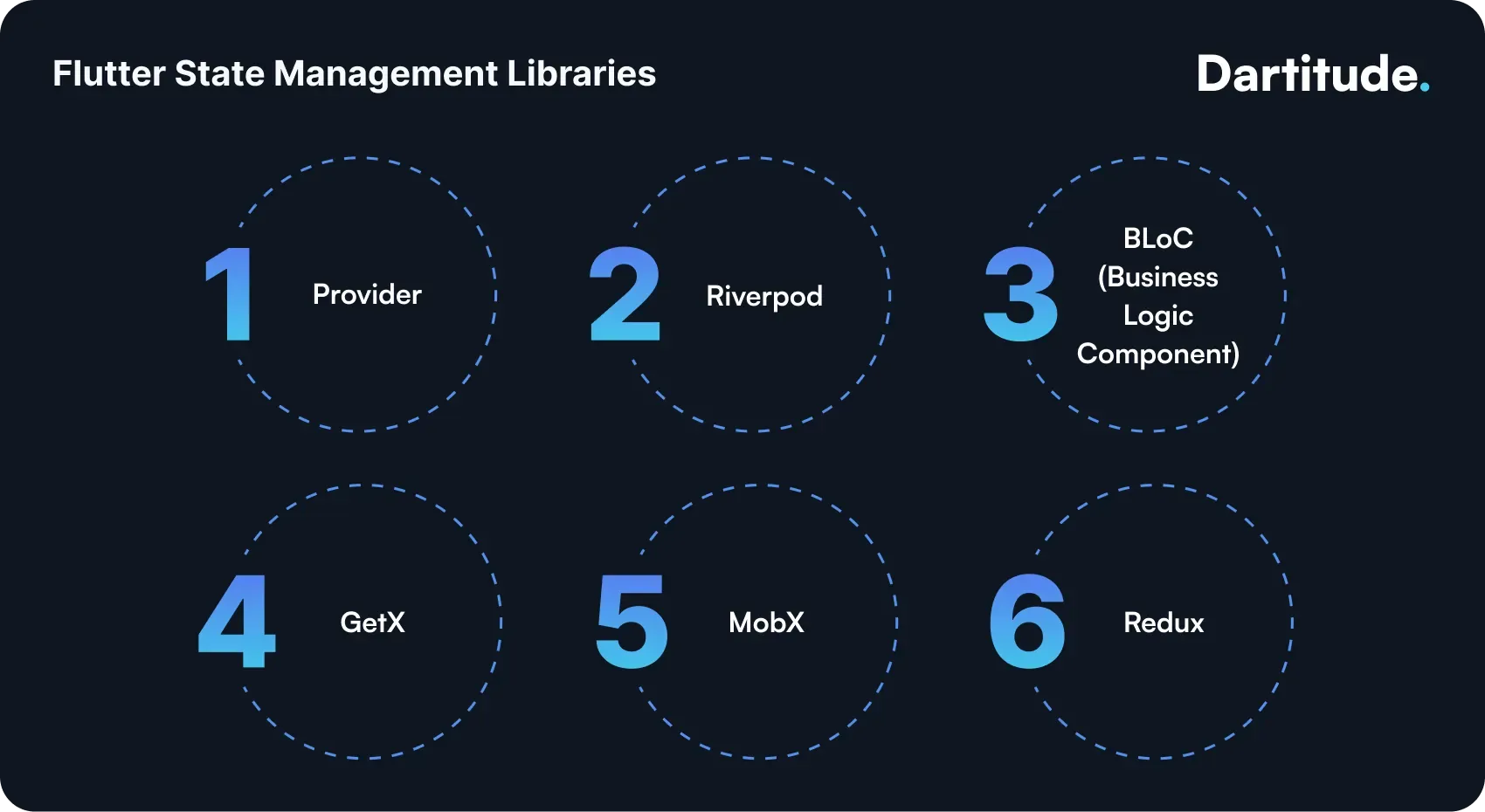
If you want your app to run without any lag, then opting for the correct state management library is essential. Below is the list that will help you to choose:
1. Provider
This library is supported by Google for scalable shared state. It is best for beginners and apps that don't need heavy architecture. This library is easy to combine with ChangeNotifier, and it is also flexible.
2. Riverpod
It is a more powerful, safer version of Provider. It removes BuildContext limitations, making code cleaner and more easy to test. A library is best suitable for apps expected to grow or evolve.
3. BLoC (Business Logic Component)
Bloc state management in Flutter is most used libraries, especially for enterprise-grade applications especially useful for enterprise-grade architecture since it separates complex logic from UI using streams and events. It ensures testable workflows that large teams can expand and maintain easily.
4. GetX
It combines state management, routing, and dependency injection in one lightweight package. The main benefit of GetX is that it boosts development with minimal boilerplate. It also provides better performance and is best applied for MVPs and small to medium apps.
5. MobX
This library utilises observables and reactivity to update UI automatically when state changes, minimizing manual logic. Its reactions make UI more complex, smoother, and more look like natural. MobX excels in apps that require seamless reactive user experiences.
6. Redux
This Library mostly uses one place to store all the data of apps. It becomes easier to track or manage the changes in apps. Everything is done strictly as per the steps and guides. Moreover, change can be seen by developers at any time.
Key Note: Selecting the right Flutter state management libraries can have a direct impact on your app's performance. Make sure to select libraries as per the app configuration.

Comparison of Popular Flutter State Management Approaches
Let me help you in deciding to choose the right solution for your project. Here’s a quick side-by-side comparison of the most widely used Flutter state management approaches in 2026.
| Library | Complexity | Best For | Performance | Boilerplate | Learning Curve |
| Provider | Low | Small–mid apps | High | Low | Easy |
| Riverpod | Medium | Mid–large apps | Very High | Low | Medium |
| BLoC | High | Enterprise apps | Very High | High | Hard |
| GetX | Very Low | Fast development | Very High | Very Low | Easy |
| MobX | Medium | Reactive apps | High | Medium | Medium |
| Redux | High | Enterprise projects | High | Very High | Hard |
The table easily shows how you can choose the right state management approach. If still not sure about which state library fits your product, you can always hire Flutter app developers to guide you to a better decision.
Critical Evaluation of State Management in Flutter
A well-chosen state management approach helps Flutter apps stay stable, consistent, and easy to enhance over time. Let's dig in.
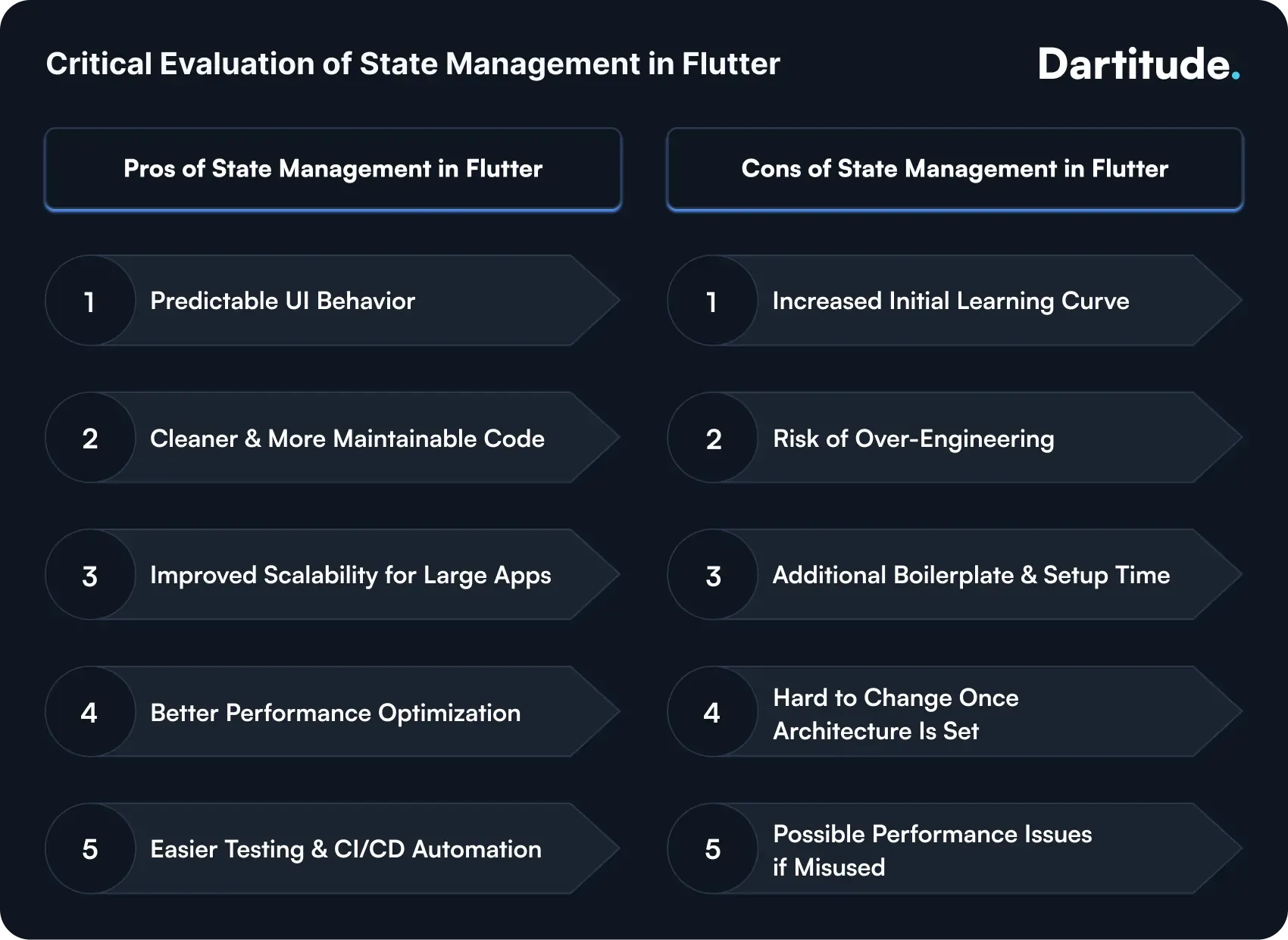
Pros of State Management in Flutter
Here are some of the pros of state management in Flutter:
1. Predictable UI Behavior
A robust state management architecture ensures the UI is updated when required, minimizing unexpected screen changes. This reliability enhances the user's trust and makes the interface more stable.
2. Cleaner & More Maintainable Code
Yes, a state architecture separates UI from business logic, maintains code well organised and easy to understand. Developers can see the changes faster that occur without searching through multiple files. This results in fast debugging, smoother onboarding, and better stability.
3. Improved Scalability for Large Apps
Structured state management allows apps to expand without creating problems in existing functionality. New features can be rolled out, making logic more predictable. This makes it best suitable for enterprise-level apps that change continuously.
4. Better Performance Optimization
If the app has proper state handling, it reduces the irrelevant widget rebuilds and avoids heavy UI elements. This results in fast transitions and a more responsive interface.
5. Easier Testing & CI/CD Automation
As business logic is separate, it is easier to write unit and integration tests. Functionality can be tested without depending on UI layers or manual checks. This enhances release quality and enhances CI/CD workflows for faster, safer deployments.

Cons of State Management in Flutter
Here are the major drawbacks developers and Flutter App Development Companies must consider when choosing a state solution:
1. Increased Initial Learning Curve
Properly examining state management tools such as BLoC or Redux requires time and practice. Beginners might find it difficult to understand concepts such as streams, events, or providers. This can slow early development until the team becomes comfortable with the selected approach.
2. Risk of Over-Engineering
There is a risk of additional technical workloads because when applying a complex state management solution to a simpler app, it can lead to unnecessary complications. Developers might spend more time wiring logic than building useful features. This led to unnecessary effort and made it difficult to maintain smaller projects at a time.
3. Additional Boilerplate & Setup Time
In some apps, they need additional methods and demand additional setup, states, controllers, and more. This enhances code volume and reduces the speed of the initial development process.
4. Hard to Change Once Architecture Is Set
That's right! If you are switching from one state management to another, it can be time-consuming and expensive, too. Selecting the wrong pattern in the initial process could restrict the scalability and success.
5. Possible Performance Issues if Misused
If any kind of implementation is done in the wrong way, it can cause excessive widgets to rebuild, which further impacts the performance negatively. Avoid heavy logic in the wrong provider. The system remains effective only when applied correct roadmap.
Remember: Apps with the right state management approach can have 30–40% fewer UI bugs and faster feature delivery, making early architectural decisions important for long-term success.
How to Choose the Best State Management in Flutter (Decision Matrix)
Selecting the right approach shouldn’t feel overwhelming. Mismanaged state leads to approximately 55% of unnecessary widget rebuilds. Here’s a decision matrix that will be helpful:
| If your app needs | Use | Why |
| Fast MVP | GetX | Minimum boilerplate, quick development, recommended for launching the app faster. |
| Enterprise stability | BLoC | Predictable, testable workflows, built for complex systems. |
| Complex reactive UI | MobX | Automatic reactions and observable streams for smooth, dynamic UI updates |
| Clean architecture | Riverpod | Highly modular, test-friendly, and avoids BuildContext limitations. |
| Beginner-friendly setup | Provider | Simple, scalable, and officially recommended, perfect for newcomers |
This decision matrix helps you make the right choice when picking up state management libraries and avoids misalignment. It is main reasons why 40% of Flutter projects face performance issues.
Thus, going with the right pattern early ensures your architecture remains scalable, maintainable as your app grows.
Conclusion: Strong State Management = Strong Flutter Apps
Are you confused about selecting the right state management in Flutter? It is the most common issue faced by developers during the early stage. Most of the developers choose the wrong architecture, creating issues ahead for all.
A strong architectural choice minimises UI bugs, prevents unnecessary rebuilds, and ensures your app stays scalable as new features and users are added over a period of time.
With Dartitude Labs guiding your Flutter development, you get a partnership and a reliable partner who builds performance-driven, future-proof app designs to expand your business goals.

FAQs
1. What is the most applied state management approach for Flutter?
There is no best state management; it all depends on app requirements. For example, Riverpod and BLoC are specifically opted for structured and scalable apps, GetX is ideal for fast MVPs, and Provider is good for beginner apps.
2. Is BLoC still relevant today?
Yes, BLoC is the most trusted enterprise architecture as it offers predictable, testable, and scalable workflows, which can be beneficial for larger teams and they can rely on.
3. Should I use Provider or Riverpod?
If you are aiming to build a mid-sized app, then go for Provider. You should only adopt Riverpod if you want to have a clear architecture, with few build content limitations.
4. Why do Flutter apps slow down due to state management?
It has been seen that poorly managed state management resulted in 55% unnecessary widget rebuilds, heavier UI operations, improper data flow, thus all causing lagging performance.
5. Can I change state management later in the app?
You can, but that will be quite expensive. Changing the complete state management will have an impact on the entire code base. Picking up the correct path will save you time.


