
Top Apps Built with Flutter Framework Powering Modern Digital Products
Apr 7, 2025
Share Article


Key Takeaway
- Statista survey: According to Statista, Flutter is known as the widely adopted cross-platform mobile framework used by developers around the world, according to a 2023 developer survey. Based on the survey, 46 percent of software developers utilize Flutter.
- Cross-Platform Efficiency: Flutter enables building apps for iOS, Android, web, and desktop using a single codebase, saving up to 50% development time and 60% fewer developers compared to native apps.
- Proven Performance & Scale: Over 2M+ developers worldwide use Flutter, and top apps like Google Pay (500M+ downloads) and Nubank (50M+ users) reflected 30% faster performance and smoother UX across platforms.
- Enterprise & Startup Ready: From BMW and Alibaba to fintech startups, Flutter enables high-performance, scalable, and visually seamless apps, reducing iteration time from weeks to hours.
Flutter is also known as the best framework for cross-platform app development as it give developer flexibility to build iOS, Android, web, and desktop apps from a unified platform, across different platforms, reducing time and manual efforts.
Is Flutter good for large apps? Definitely. It is used with the aim of building large-scale, high-traffic applications with millions of users.
With over 2M+ developers worldwide and performance improvements of up to 55%, leading brands like BMW, Google, and Alibaba choose Flutter to provide secure and scalable applications.
Let’s dig in further to check out how Flutter has become a trusted framework globally.
Why Use Flutter for Development and Its Role in App Development?
Flutter is an open-source SDK that enables enterprises to create high-quality apps for different platforms by the use of a single codebase. Modern Flutter app development services aim on providing faster releases, the same user experiences, and near-native performance across platforms.
Key Benefits of Flutter
Here are the main advantages offered by Flutter:
- Single Codebase: Build and maintain apps for multiple platforms
- High Performance: Provide you with native speed with smooth animations and a responsive UI.
- Rapid Development: Hot reload enhances testing, iteration, and feature updates.
- Scalable & Consistent: It makes sure uniform UX and easy updates across iOS and Android.
- Strong Community Support: Complete access to libraries and plugins.
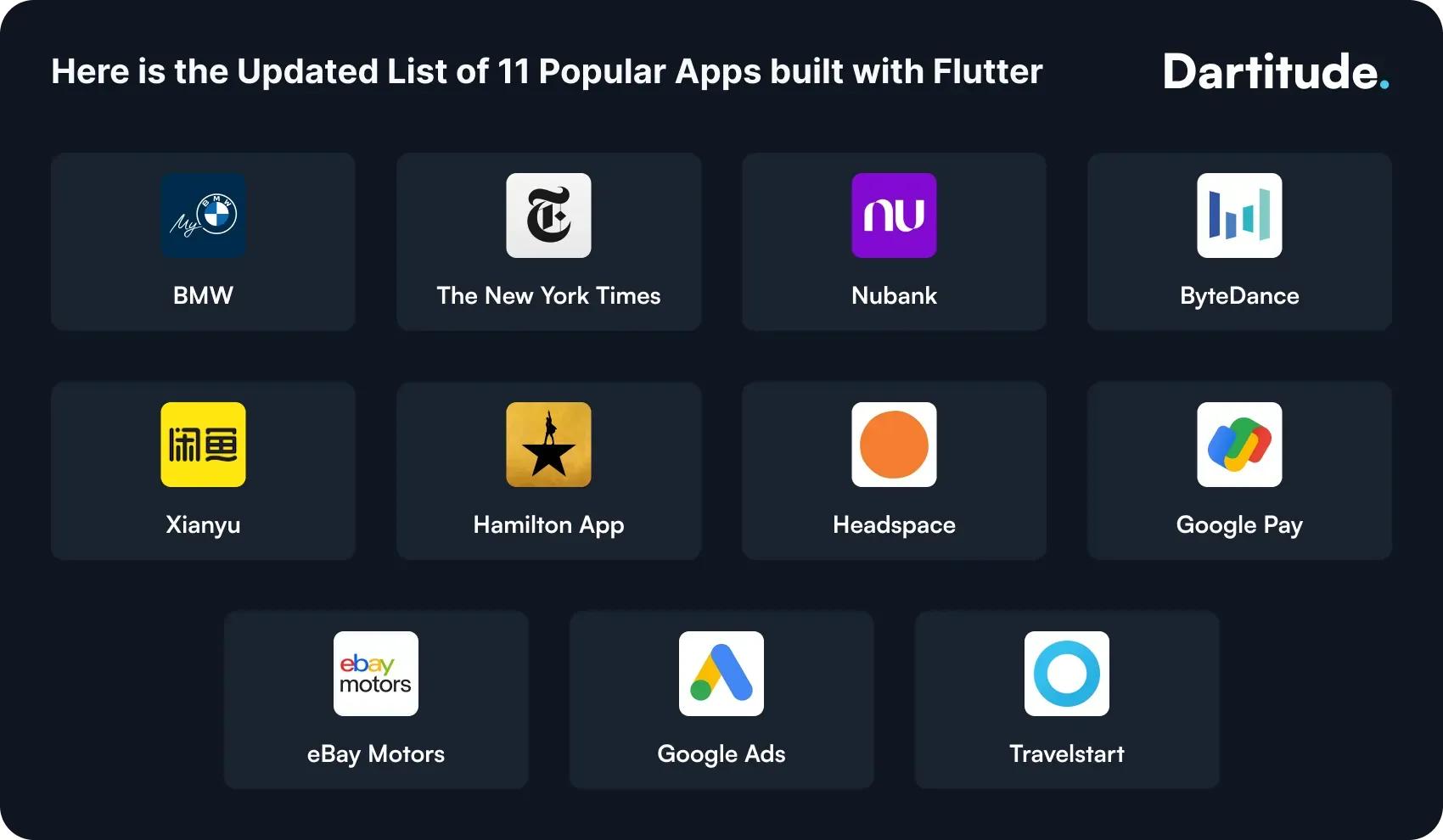
Here is the Updated List of 11 Popular Apps built with Flutter
1. BMW App (My BMW)
Before Flutter
Before the launch of the My BMW app, BMW’s connected vehicle experiences were mostly built with native iOS development, with Android to be handled in a separate way.
This method results in:
- Gaps in features between iOS and Android versions
- More effort was required to maintain consistency across different platforms
- Slow updates of connected-car features worldwide
After Adopting Flutter
Around 2020–2021, BMW completely rebuilt its My BMW app through the use of Flutter and Dart to work across both iOS and Android from a unified platform.
What changes came out:
- Unified development for both platforms
- Same feature available across iOS and Android
Solution: Flutter made it easy for BMW to move from a platform-heavy native setup to a shared mobile architecture, enabling the firm to maintain feature variance and provide aconsistent connected-car experience across various regions without hiring additional team.
2. The New York Times
Before Cross-Platform Framework Expansion
The New York Times was initially using platform-specific and React-based architectures around their digitalized products:
- They were deploying React Native for core mobile applications to deliver near-native performance
- React + GraphQL powered the main NYTimes.com web experience
- Additional teams and stacks were needed for mobile and web experiences
Problem: This method delivered a high-end performance, but it needed a development team and efforts at large, with careful coordination between platforms.
After Adopting a Multi-Framework Strategy
Later, NYT expanded its digital services, focused more on Flutter for select, highly interactive or experimental cross-platform initiatives, while continuing to depend on React and React Native for major products.
This resulted in:
- Faster prototyping for new interactive experiences
- More easy for experimentation among mobile and web
- Reduced overhead for non-core, feature-rich applications
Solution: Instead of removing its current stack, The New York Times decided to go with Flutter, taking React and React Native, selecting the right framework based on product needs. This flexible practice allows NYT to innovate quickly.
3. Nubank
Before Standardizing on Flutter
Initially, for their mobile architecture, Nubank was heavily dependent on a combination of native development and React Native:
- Native Android (Kotlin) and iOS (Swift) for important banking features
- React Native for shared UI and fast feature delivery
- Several codebases lead to more maintenance effort
Problem: With the expansion of the product, this approach made it really difficult to keep consistency and roll out updates faster across platforms.
After Adopting Flutter As The Main Model
Between 2019 and 2020, Nubank transform their mobile apps to Flutter as the main framework.
This shift allows them to:
- A shared Flutter codebase for most new features
- Faster development and release cycles
- Improved consistency across Android and iOS experiences
By 2021–2022, Nubank focused to go with a mixed environment, where:
- New features were built in Flutter
- Legacy modules written in native or React Native were migrated easily
Solution: Due to this, Nubank has been able to maintain mobile development without facing any risk, supporting gradual migration while keeping millions of users engaged with their app.
4. ByteDance (TikTok, Lark, Douyin & Others)
Before a Unified Cross-Platform Strategy
With the expansion of ByteDance’s product portfolio, mobile development is based heavily on:
- Native iOS and Android for performance- based features
- React Native–style solutions for shared UI and quicker iteration
- Multiple frameworks across teams, enhancing architectural fragmentation
Problem: This worked at broade scale, but challengeswere there around productivity and consistency.
After Adopting a Multi-Framework Model
ByteDance evolved toward a best-tool-for-the-job approach, combining Flutter, native code, and in-house frameworks:
Flutter
- Most heavily used in Lark, which ByteDance has cited as a successful Flutter adoption.
- Successfully deployed across several new or smaller apps to improve development speed.
Native (Swift, Kotlin, C++)
- Retained for high-performance video rendering and playback in TikTok and Douyin
Lynx (In-House Framework)
- Developed to address limitations seen in React Native
- Used for dynamic, web-technology-driven UI and feature modules
Solution: Rather than focusing on a single framework, ByteDance aims for scale, performance, and developer efficiency. To increase productivity, Flutter is the main framework,d whereas native code and Lynx handle performance-critical tasks conveniently.
5. Xianyu (Alibaba Second-Hand Marketplace)
Before Standardizing on Flutter
During the initial days of development, Xianyu adopted native Android and iOS development, with H5 (HTML5) utilized for various activities and marketing pages.
This leads to:
- Slower iteration on high-traffic product pages
- Higher maintenance cost for duplicated native UI logic
- Limited efficiency for rapid feature development
Problem: The team evaluated multiple cross-platform options, along with React Native, during this stage.
After Adopting Flutter in a Hybrid Architecture
Later inbetween 2018 and 2019, Xianyu adopted Flutter as its core framework, saying that Flutter wins over the line and provides commendable performance.
Key changes included:
- Migration of core flows (main feeds, search, and detail pages) to Flutter
- Adoption of a Native + Flutter hybrid model, not a full rewrite
- Deep integration using FlutterBoost, a hybrid routing and integration framework developed by the Xianyu team
Solution: By deploying Flutter into a native foundation instead of completely replacing it, Xianyu achieved higher development efficiency on high-traffic pages while preserving the stability and control of native systems.
6. Hamilton (Official Broadway Musical App)
The Hamilton app was also developed by deploying Flutter to deliver a high-quality, consistent experience across iOS and Android from a single codebase. Flutter was still emerging, but the team needed speed, performance, and design consistency without maintaining two separate native apps.
Built with Flutter
The app was developed by Very Good Ventures (formerly Posse) and became:
- The first commercial app built with Flutter outside Google
- Completed in just three months
- Launched even before Flutter 1.0, showing evidence of the framework’s production readiness
What Flutter Enabled
- One shared codebase for iOS and Android
- Smooth performance and polished UI
7. Headspace (Mental Wellness Platform) [2026-Update]
Before Adopting Flutter
Headspace was earlier focusing on native codebases for iOS, Android, and web. But as a result, this approach enhances their development cost at major updates, and feature updates are slow.
Why Headspace Chose Flutter
To make the process of development easy and deliver a consistent experience, Headspace made a strategic decision to migrate to Flutter. The goal was to move toward a unified, cross-platform codebase without compromising quality or performance.
Flutter in Production
- Newer features like the AI companion Ebb and mental health coaching services are already built with Flutter.
- Active hiring of Flutter engineers to improve the shift
- Shared UI and logic across mobile and web platforms
Outcome & Vision
Flutter allows Headspace to streamline development, reduce maintenance costs, and deliver a consistent, high-quality wellness experience to millions of users worldwide.
8. Google Pay
Before the Flutter Rewrite
Before 2020, Google Pay was using separate native Android and iOS codebases:
- Independent platform teams were creating duplicate solutions
- Feature rollout needs development and testing
- UX differences reflected across regions and devices
Problem: As Google Pay grows worldwide, mainly in high-growth markets like India, this framework has become increasingly difficult to scale efficiently.
After Rebuilding with Flutter
At the start of 2020, Google transformed its Google Pay app using Flutter as the main framework.
This transition resulted in:
- A single shared codebase across Android and iOS
- An app that is approximately 35% smaller
- Engineering time savings of roughly 60–70%
The Flutter-based Google Pay app now represents one of the largest production deployments of Flutter, particularly across India, Singapore, and global markets.
Solution: Flutter enabled Google Pay to consolidate mobile development at scale, improving consistency and velocity while supporting the demands of a globally distributed financial application
9. eBay Motors (Automotive Marketplace App)
Why Flutter Was Used
As the main eBay app is not really built with Flutter, eBay opted for using Flutter for its eBay Motors app to boost the development and provide a consistent experience around iOS and Android from a shared codebase.
Built with Flutter
The eBay Motors app was developed using Google’s Flutter UI toolkit, focusing on speed, scalability, and cross-platform consistency for vehicle buying and selling.
What Flutter Enabled
- Faster Development: A beta version was launched in just three months.
- High Code Reuse: About 98.3% code sharing across iOS and Android, reducing separate platform backlogs
- Better Developer Experience: A complete team reported that they enjoy using Flutter more than native development, as it is twice as fast as any other framework.
10. Google Ads
Google Ads is using Flutter to work across iOS and Android development into a single codebase, allowing faster feature delivery and constant UI across platforms. Flutter allows the team to reuse complex UI components and maintain performance while reducing long-term maintenance overhead for a large, data-heavy business application.
11. Travelstart
Travelstart also changed its application to Flutter as the core framework, consolidating iOS, Android, and web into a single shared codebase.
As a result:
- The overall codebase was down upto 85%
- The mobile engineering team size was reduced by around 65%
- Flutter Web was used to power the mobile web experience
Its efficient performance and scalability showcase the future of Flutter for web app development.
If you are keen on uplifting high-quality apps, then hire Flutter developers at Dartitude Labs; that's what you need. We help you convert your business idea into a functional, user-centered design!
Conclusion: Build Smarter, Faster, and Better with Dartitude Labs
Looking to build an extraordinary app with Flutter?
Flutter’s hot reload, seamless cross-platform capabilities, and AI-ready framework are the app development time-savers.
- At Dartitude Labs, making apps doesn't just mean constructing an app; we build elegant experiences.
- Experience the smooth operation of an App as we marry creativity with technology and bring your ideas.
If you feel to bring innovation to your app, then let's step into this journey to create something epic, a Flutter app at a time!
FAQs
1. What are the most popular apps built with Flutter?
Here are the top apps that are built with Flutter: Google Pay, BMW, Xianyu, Nubank, and more. These brands adopts Flutter framework for higher performance, faster development cycles, and cross-platform scalability.
2. Why do companies like Google Pay choose Flutter for app development?
Yes. Google Pay chooses Flutter to transform its iOS and Android codebases, minimising maintenance effort by up to 65% while enhancing feature releases. Flutter’s hot reload and native-level performance make updates faster and more cost-effective,
3. How does Flutter help brands like BMW, Alibaba, and Nubank scale large apps?
Flutter allows enterprises to manage millions of users without compromising performance or UX:
- BMW: Delivers cross-platform digital experiences and interactive e-brochures
- Alibaba Xianyu: Supports rapid development and frequent updates for 50M+ users
- Nubank: Uses a unified codebase for secure, high-performance mobile banking
4. Flutter vs React Native 2026: Which is better for cross-platform app development?
In Flutter vs React Native 2026, Flutter wins over all phases due to its features, such as consistent UI across platforms and better performance for complex animations.
5. Is Flutter better for startups or enterprise app development?
Flutter works for both startups and enterprises at wider scale.
- Flutter for startups: To startups, it delivers fast MVP development, affordable cost, and quick iteration with hot reload
- Flutter for enterprise: Scalable architecture, well-protected integrations, and support for millions of users.


