
How to Hire a Flutter Developer for an Existing Team Without Slowing It Down
Paresh Mayani
Sep 8, 2026
Share Article


Your team already ships. You have a repo, a release cadence, a code review habit, and a backlog that keeps growing. What you don't have is enough Flutter capacity. So you go looking for one good engineer, and every vendor page you open says the same three things: vetted, senior, available in 48 hours
None of them answer the question you actually have. Which is: what happens on Monday?
Here's the short version. When you hire a Flutter developer for an existing team, the hiring decision is about 30% of the outcome. The other 70% is integration: whether they can read your codebase, whether your state management pattern is documented anywhere, who owns the release pipeline after they arrive, and how fast they get commit rights. Teams that plan those four things get a merged pull request in week one. Teams that skip them lose the first month to onboarding drag and then blame the developer.
We've been building Flutter apps at Dartitude since the early days of the framework, and we've joined a lot of teams mid-flight. This guide covers what breaks, why, and the onboarding sequence we use to avoid it.
What "Hire a Flutter Developer for an Existing Team" Actually Means
This phrase covers four pretty different situations, and the right answer changes depending on which one you're in.
You have a Flutter app and not enough hands. Your team knows Flutter. You just need more throughput to hit a date. This is the easiest case. The new developer needs your conventions and your CI access, and that's mostly it.
You have a Flutter app and a missing skill. Maybe nobody on the team has shipped a custom platform channel, or handled a nasty performance problem on low-end Android, or set up a proper release train. You're not buying capacity here. You're buying a specific skill for a specific stretch.
You have a native app and want to start using Flutter. Your team writes Kotlin and Swift. Now someone wants a new module built once instead of twice. This is the hardest case and the most common one we get asked about.
You have no mobile team, only backend and web. Your Flutter developer becomes the mobile function, not an addition to it. Different problem, different answer.
Be honest about which one you're in before you talk to anyone. In our experience, most confusion in these engagements traces back to a company thinking it was in situation one when it was really in situation three.
Your Existing App Decides How a Flutter Developer Joins It
This is the section nobody else writes, and it's the one that saves you the most pain.
If your app is already Flutter, skip ahead. If your app is native Android or iOS, a Flutter developer cannot just start committing. The framework has to be brought into your build first, and that's a real piece of engineering work with a name: add-to-app.
Add-to-app lets you pull Flutter into an app that already exists, as a module, so part of your app renders with Flutter and the rest keeps running on what you already have. Per Flutter's own documentation, it's supported on Android, iOS, macOS, and web as of 2026. Two common shapes:
- Hybrid navigation stacks. Some screens are Flutter, some aren't, and users move between them without noticing.
- Partial-screen views. A Flutter widget sits inside an existing native screen. Good for one complicated component, like a chart or a booking flow.
There's a detail here that changes how you plan. Running more than one Flutter instance in a host app used to be expensive. It isn't anymore. Flutter's documentation puts the extra memory cost of each additional instance at roughly 180kB, because instances spawned from the same FlutterEngineGroup share the GPU context, font metrics, and isolate group snapshot (Flutter documentation, 2026). Communication back to the host happens over platform channels, or Pigeon if you want generated type-safe bindings.
Why does any of this matter when you're just trying to hire someone?
Because it tells you what to screen for. A Flutter developer who has only ever worked in Flutter-only repos will struggle here. You need someone who has done the plumbing: engine lifecycle, channel design, and the build-system changes on both Gradle and Xcode. That's a narrower pool than "senior Flutter developer," and if you don't ask about it you'll find out in week three.
If you're going further than a module and want the whole app moved over, that's a different scope again, and we cover it under Flutter app migration.
Three Engagement Models, and the One Most Teams Pick Wrong
There are only three real options once you decide to add Flutter capacity from outside.
Freelancer
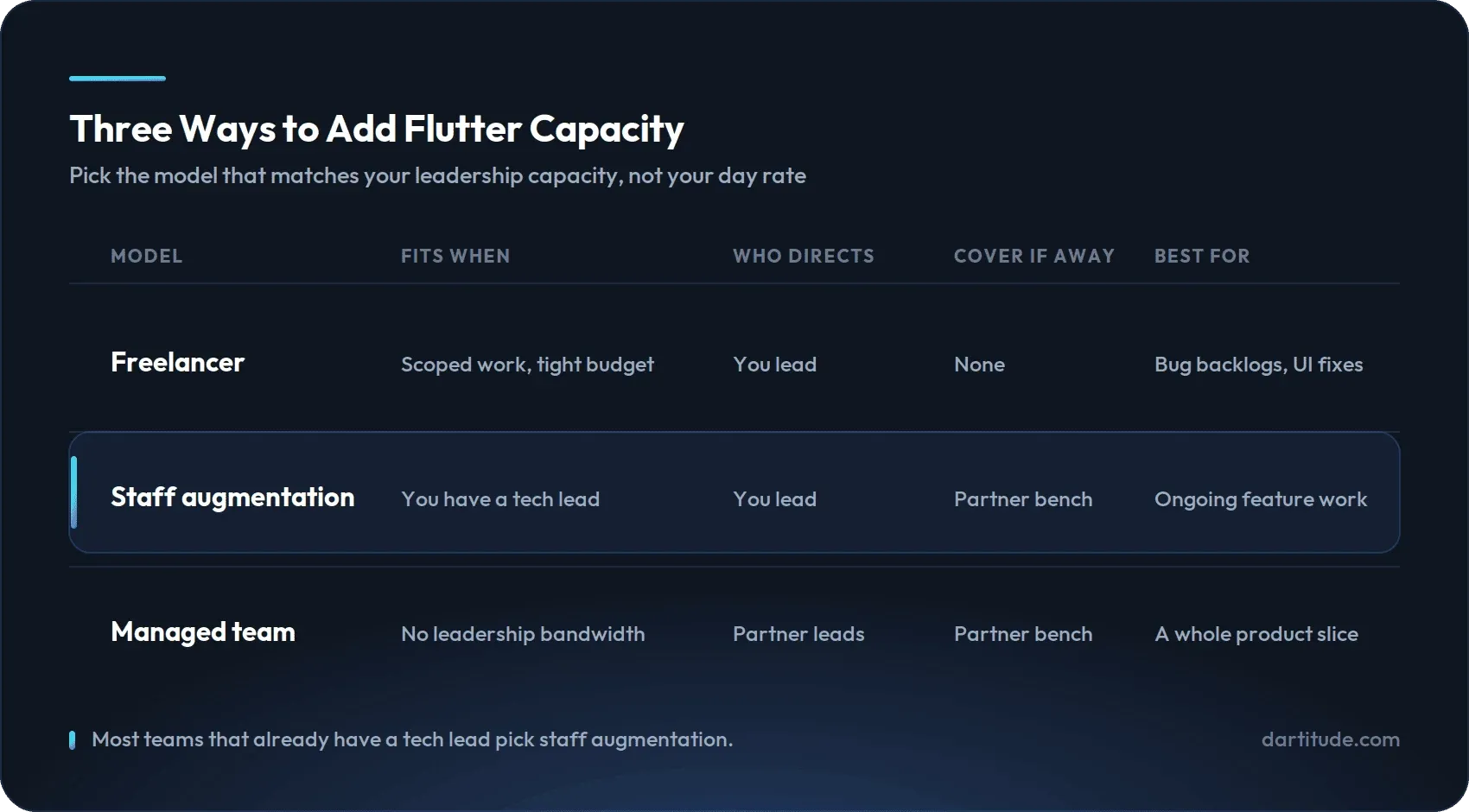
You contract an individual directly. Cheapest sticker price, fastest to start, and fine for scoped work like a bug backlog or a UI refresh.
The failure mode is bench depth. When your freelancer goes quiet, disappears for a family emergency, or takes a full-time offer, you have nothing. No handover, no backup, no continuity. We've been called in to pick up half-finished freelance work more than once, and reading someone else's abandoned branch is slower than writing it fresh.
Staff augmentation
An engineer from a partner joins your team. Your repo, your sprints, your standups, your tech lead. The partner handles employment, benefits, replacement, and bench cover.
This is usually the right pick when you already have engineering leadership. You keep architectural control. You get continuity. And you can flex the number up or down as the roadmap changes without a hiring cycle each time.
Managed team
A partner takes a slice of the product and delivers it, with their own lead, their own process, and an outcome you review.
Good when you don't have the leadership bandwidth to direct another engineer. Bad when you do, because you end up with two decision-makers and a slow argument about architecture.
Here's the mistake we see most often, and it's specific: teams with a strong tech lead buy a managed team because it feels lower-effort, then spend six weeks fighting over patterns. If you have someone who can direct the work, augment. If you don't, hand over a whole slice. Picking the model that matches your leadership capacity matters more than the day rate.
Five Things That Break in the First Month
These are the actual failure points, in rough order of how often we run into them.
- State management mismatch. Your app uses Bloc. Your new developer has spent three years in Riverpod. Both are fine choices. Mixing them inside one feature is not. This needs deciding on day one, in writing, and the answer is always "match what exists" unless you've already agreed to migrate.
- Nobody wrote down the conventions. Folder structure, naming, where models live, how you handle errors, whether you use freezed. Your team knows all of it and none of it is documented. A good developer will reverse-engineer it from the code in about a week. That's a week you paid for.
- Release ownership stays vague. Who signs the build? Who holds the signing keys and the App Store Connect access? If the answer is "we'll sort it out later," later means the day before your release, at 11pm.
- Code review becomes a bottleneck. Adding a developer adds review load to your existing seniors. If your one Flutter-literate reviewer is already at capacity, throughput does not increase. It just moves the queue.
- Flutter version drift. Flutter ships four stable releases a year in 2026, with 3.47 landing in August (Flutter blog, 2026). If your app is pinned to something eighteen months old and the new developer's local setup is current, you'll get build failures that look like code problems and aren't.. Also worth knowing: Material and Cupertino are being pulled out into separate packages, so design system updates no longer wait for an SDK release. Nice for you, but it's one more version axis to pin.
Every one of these is preventable with a checklist. None of them are the developer's fault.
A 30-Day Plan That Gets a Flutter Developer Shipping in Week One
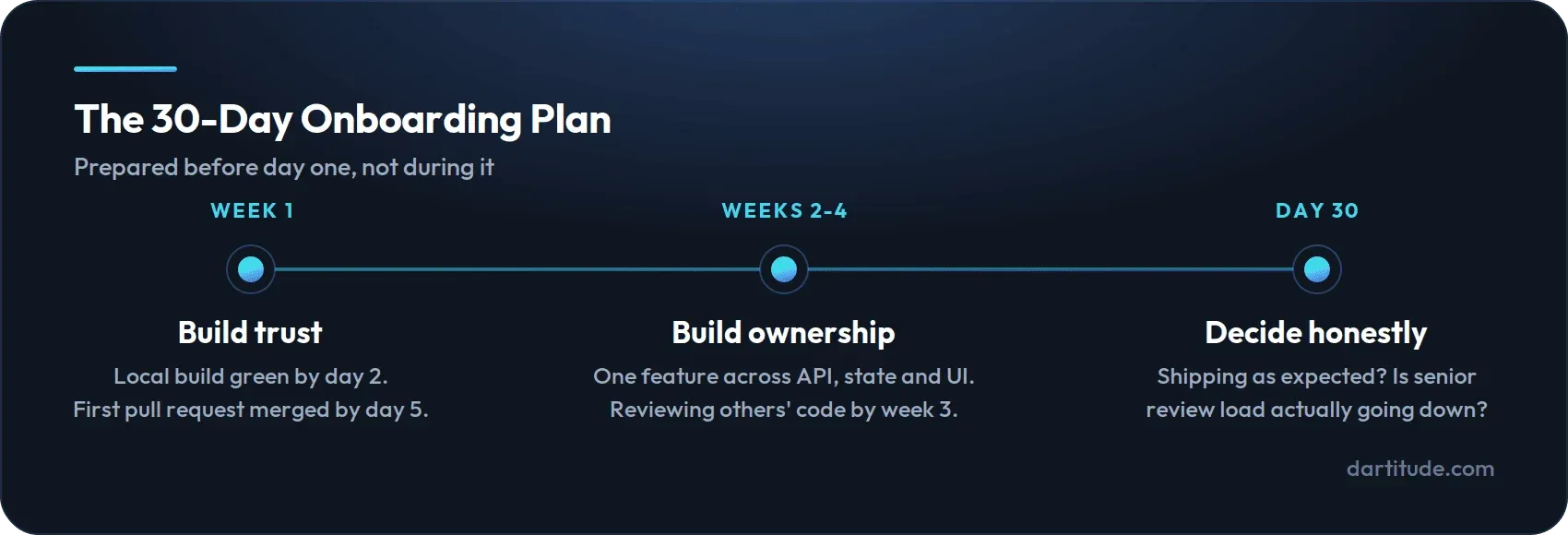
This is the sequence we use. It's not complicated, but it does have to be prepared before day one, not during it.
Before day one
Have these ready and the first week takes care of itself:
- Repo access and commit rights, actually granted, actually tested
- A README that says how to run the app locally, including the exact Flutter and Dart versions
- One page on architecture: state management choice, folder layout, error handling, testing approach
- CI access, and confirmation the pipeline runs green on their machine
- A named buddy on your team who has time booked to answer questions
- Two or three small tickets picked out. Real ones, in the codebase, low blast radius
That last one does more work than the rest of the list put together. A first pull request that ships in week one changes the whole tone of the engagement.
Week one, build trust
Local environment running by day two. First pull request open by day three or four, merged by day five. The tickets should be small on purpose: a UI fix, a copy change, a test that was missing. You're not measuring output yet. You're verifying that the pipeline from their laptop to your main branch works end to end.
Weeks two to four, build ownership
Give them a feature with edges. Something that touches the API layer, the state layer, and the UI, so they have to learn how your app is wired. They should be joining code review as a reviewer by week three, not just an author. If they're still only receiving reviews at week four, something's wrong with the onboarding, not the engineer.
Day 30, decide honestly
Three questions. Are they shipping at the level you expected? Are they reducing load on your seniors or adding to it? Do they raise problems before you find them?
A good partner will replace someone who isn't working out without an argument. Ask about that policy before you sign, not after.
Questions Worth Asking Before You Sign
Skip the generic ones. These are the ones that actually separate partners.
- Has this developer worked in a codebase they didn't start? Ask for a specific example.
- Which state management patterns have they shipped to production, plural?
- Have they done add-to-app integration into a native app? If your app is native, this is not optional.
- Who owns release engineering after they join, us or you?
- What Flutter version will they work in, and who decides when we upgrade?
- What happens in week one if their local build doesn't work?
- What's the replacement process, and how fast?
- Will they be full-time on us, or split across accounts?
- What does handover look like if we end the engagement?
Question eight catches more problems than the rest combined. A developer split across three clients will always deprioritise the one that complains least.
And a few things that should make you pause. Vagueness about who the specific engineer is. A rate that's far under the market with no explanation of why. No written replacement policy. Reluctance to let you interview the person before they start. None of these are automatically disqualifying, but each one deserves a straight answer.
What It Costs to Add a Flutter Developer to Your Team
Rates depend on three things, in this order: seniority, region, and engagement model. Public rate surveys put Flutter developers in a wide band, from around 25 USD per hour in India to well over 100 USD per hour in the US and Western Europe (aggregated from published 2026 rate guides). Regional averages are a starting point, not a quote.
What matters more than the hourly number is what the number includes. Compare properly:
| Cost line | Freelancer | Staff augmentation | In-house hire |
| Hourly or monthly rate | Lowest | Mid | Mid, plus payroll |
| Recruitment cost | Low | None | High |
| Time to productive | 1 to 2 weeks | 1 to 2 weeks | 2 to 4 months |
| Cover when they're away | None | Partner bench | Team absorbs it |
| Replacement risk | Yours | Partner's | Yours, plus rehiring |
| Code review and QA included | No | Usually | Internal |
The honest comparison isn't rate versus rate. It's total cost of getting a working feature shipped, and that calculation almost always turns on time-to-productive and who carries the replacement risk.
Getting It Right
When you hire a Flutter developer for an existing team, you're not really buying code. You're buying throughput inside a system that already has its own habits, and throughput only shows up if the integration is planned.
So the checklist is short. Know which of the four situations you're in. Pick the engagement model that matches your leadership capacity, not your budget spreadsheet. If your app is native, screen hard for add-to-app experience. Write down your conventions before anyone arrives. And prepare three small tickets so the first pull request lands in week one.
Do those five things and a new Flutter engineer starts paying for themselves in the first month. Skip them and you'll spend that month wondering why the hire isn't working.
Frequently Asked Questions
1. How long before a new Flutter developer is actually productive on our codebase?
With onboarding prepared in advance, expect a merged pull request in week one and independent feature work by week three. Without preparation, the same developer takes four to six weeks to reach the same point. The difference is almost entirely on your side, not theirs.
2. Can one Flutter developer replace our separate iOS and Android developers?
For a single shared codebase, often yes. But keep native knowledge somewhere on the team. Platform channels, store submissions, and OS-specific bugs still need someone who understands the platform underneath.
3. Should the developer work in our repo or their own?
Yours. Always. Separate repos create an integration debt that grows quietly and gets paid all at once, usually right before a deadline.
4. What if we're not sure Flutter is the right choice yet?
Then don't hire for it yet. Scope a short technical assessment against your actual product needs first. We look at this trade-off in more detail under cross-platform app development.
5. Do we need to change our sprint process to bring in an outside developer?
No, and you shouldn't. The point of augmentation is that the engineer adapts to how you already work. If a partner asks you to change your process to accommodate them, that's a managed-team engagement wearing an augmentation label.


