
Hiring a Flutter App Development Company in 2026? Ask These 12 Questions First
Paresh Mayani
Aug 24, 2026
Share Article


The short version
A Flutter app development company builds apps for iOS, Android, web, and desktop from one Dart codebase. That’s the brochure definition. In 2026 the good ones do a lot more: they handle the framework’s constant migrations, they know what to do when a plugin quietly dies, and they’ll tell you which parts of your product shouldn’t be Flutter at all.
Here’s the filter that actually works.
Pick the partner who can send you a live Flutter app on a store listing, name their state management default without hedging, and describe how they’ll upgrade your SDK a year from now.
Three things. That’s the whole test. The rest of this piece explains why those three matter more this year than they did last year, and what to do when a vendor fumbles them.
Start with a statistic you should probably stop trusting
Search “Flutter market share” right now. You’ll see the same two numbers on almost every agency page: 46% of developers use Flutter, 35% use React Native.
That data is from 2023.
It came out of a Stack Overflow survey published in June 2023, and it lives on as a Statista chart covering 2019 through 2023. Agencies republish it constantly with a “2026” badge slapped on top. Some park a market-size figure next to it and present the whole arrangement as fresh research, which it isn’t.
Why should you care during vendor selection? Because it’s a tell. If a company can’t be bothered to check the date on a statistic sitting on its own homepage, think about how carefully it’ll check the version number on your payment SDK.
So what’s current?
Google published its Flutter Q2 2026 developer survey in August. Over 3,500 complete responses, collected across two weeks in June. Satisfaction sat at 93% positive. The more interesting number is underneath that: 58% said they were very satisfied, up six points from Q4 2025. Trust in Flutter to meet real development needs climbed from 77% to 83%.
That’s a better signal than raw adoption. It’s not just that a lot of people use Flutter. It’s that the people already using it got happier.
Four things changed in Flutter this year. Most agency sites haven’t noticed.
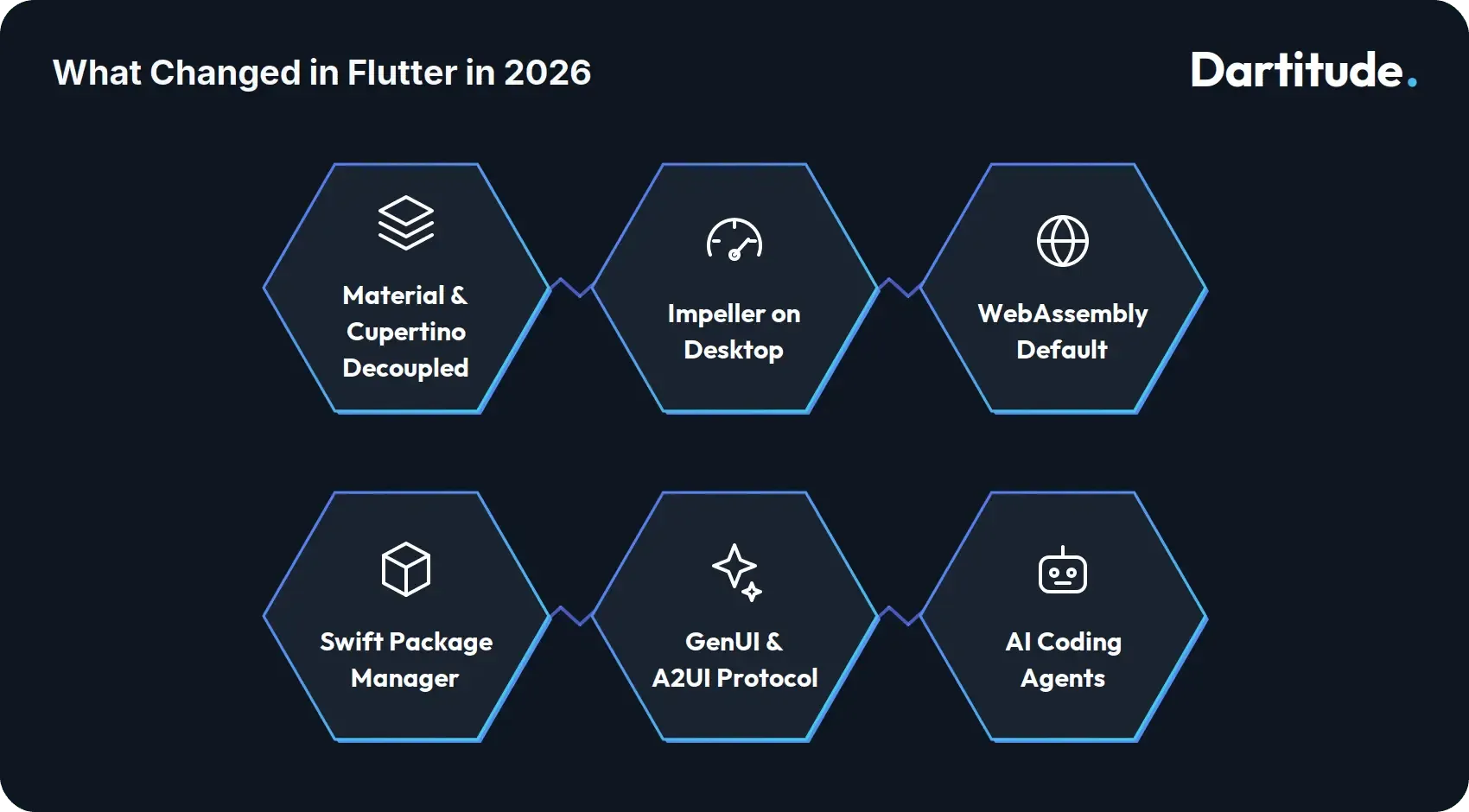
I’d argue these four are the sharpest vetting questions available to you right now, purely because so few vendors have updated their thinking.
Material and Cupertino moved out of the SDK
Flutter 3.47 landed on 12 August 2026. With it, Google published material_ui and cupertino_ui as standalone 1.0 packages on pub.dev. The design systems aren’t bundled into the framework by default anymore.
The core SDK still ships them, for now. But the bundled copies get formally deprecated in the November stable release.
Practically, this is a maintenance bill headed for every Flutter app in existence. The migration command is dart fix --apply --code=migrate_design_widgets. Ask whoever you’re evaluating whether they’ve run it against a production codebase yet. Their answer tells you whether they’re shipping in 2026 or still working from a 2023 playbook.
Impeller became the default renderer on desktop
macOS, Windows, and Linux all default to Impeller as of 3.47. Instead of compiling shaders at runtime, Impeller does it at build time, which kills that brief stutter you used to get the first time an animation ran.
Google’s 2026 roadmap also commits to finishing the Android side by removing the legacy Skia backend on Android 10 and up.
Commissioning anything animation-heavy? Bring this up directly.
WebAssembly is nearly the default for Flutter web
Google put out benchmark numbers in August. A test app compiled to Wasm held 60 FPS at 17.4 ms frame times; the JavaScript build of the same app dropped to roughly 30 FPS at 34.5 ms. Widget build time fell from 29.3 ms to 11.4 ms. Jitter tightened from ±1.5 ms to ±0.5 ms. Compressed bundle size grew by no more than 5%.
And Google’s own analysis found that more than 58% of existing Flutter web apps compile to Wasm with zero code changes.
There’s a real catch. Wasm needs package:web and modern JS interop, so anything still calling dart:html will break. If your scope touches Flutter web work, ask the vendor whether they’ve shipped a Wasm build and, more usefully, what broke when they tried.
CocoaPods is on the way out
Swift Package Manager became the default iOS dependency manager back in 3.44. By 3.47, 92 of the top 100 iOS plugins had migrated. CocoaPods is in maintenance mode now, and plugins that don’t move will eventually stop working.
There’s also a hard deadline buried in the iOS 27 SDK: it mandates the UIScene lifecycle for all UIKit-based apps. An app built with Xcode 27 that hasn’t adopted it won’t launch. At all. The Flutter CLI handles most of this automatically during the build, though not if you’ve got custom native code sitting in your AppDelegate.
One more from 3.47 worth noting, since it affects your install base: minimum iOS went from 13 to 15, and minimum macOS from 10.15 to 12.
The question nobody wants you to ask
When Google asked developers what actually frustrates them about Flutter, the biggest theme wasn’t the learning curve.
It was upgrading.
Forty-four percent of dissatisfaction traced back to platform and ecosystem maturity. Developers described burning hours on version-matrix guesswork with older projects, especially on Android, where Flutter, Dart, Gradle, Kotlin, and JVM versions all have to agree with each other.
I think this is the single most underrated question in vendor selection, and it almost never comes up in a sales call.
Your app is going to need SDK upgrades. Roughly four a year, given Google’s stated commitment to four stable releases annually. Somebody has to do that work. If your contract stops at launch and nobody owns upgrades, you find out about eighteen months later, usually when a store policy change forces an upgrade and suddenly nothing compiles.
So ask it word for word:
“Walk me through the last Flutter SDK upgrade you did on a client’s live app. What broke?”
A real answer has a version number in it and names a specific plugin that caused grief. Anything about “staying current with best practices” means they haven’t done it recently enough to remember.
If you want that work covered properly, it belongs in a written maintenance and support agreement. Not a handshake.
AI agents are now part of how Flutter actually gets built
This one’s recent enough that agency content hasn’t caught up at all.
Google’s Q2 2026 survey asked about editor and agent usage for the first time. VS Code led at 66%, Android Studio at 40%. Then it gets interesting: Claude Code came in at 32% and Antigravity at 23%, both ahead of GitHub Copilot (19%), Cursor (18%), and Codex (17%).
So roughly a third of Flutter developers now have an agentic coding tool in their daily workflow.
Google’s building for it on purpose. The Dart MCP server shipped mid-2025. Official Agent Skills for Flutter and Dart launched at I/O alongside agentic hot reload. The 2026 roadmap commits to more MCP work so agents can run complex refactors by talking straight to the Dart analyzer.
Here’s the part buyers get backwards. The move isn’t “find an agency that uses AI.” Nearly all of them do now, and saying so costs nothing. What matters is what surrounds it.
Ask how AI-generated code gets reviewed. Ask whether a senior engineer reads every pull request or just the risky ones. Ask about test coverage. Faster output only helps you if review kept pace, and on plenty of teams it very much did not.
The thing after that: GenUI
Google’s roadmap describes a shift toward interfaces that adapt to user intent in real time instead of being fully pre-built. It runs on the Flutter GenUI SDK and the A2UI protocol. Version 0.10.0 of the genui package shipped around 3.47 with a new a2ui_core package and support for client-side functions.
Google’s also investigating interpreted bytecode in the Dart runtime, which would let chunks of an app load on demand without pushing a full store update.
None of this is production-standard yet, and I wouldn’t hire on it. But a vendor who’s never heard of it isn’t following the framework closely.
Four kinds of partner, and who each one suits
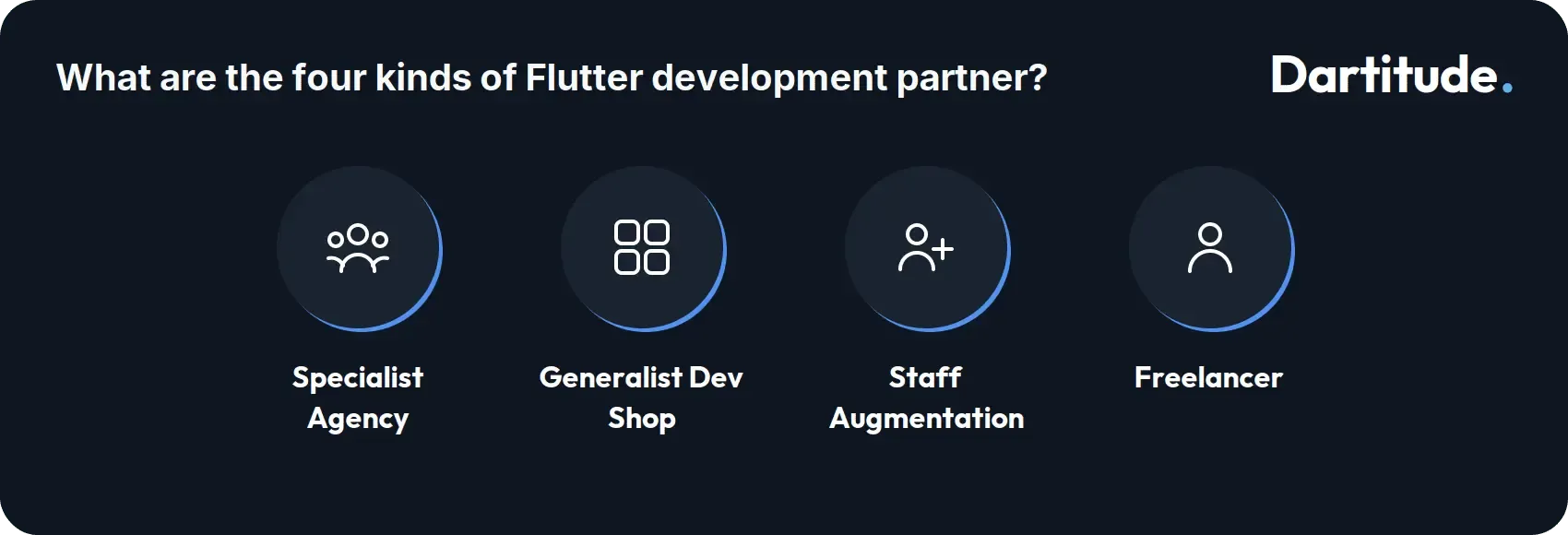
“Flutter app development company” describes four fairly different businesses. Picking the wrong category tends to cost more than picking a mediocre vendor inside the right one.
| Type | What you get | Good fit when | Watch out for |
| Flutter specialist agency | Deep framework knowledge, opinionated architecture, a team that’s hit your bug before | You need someone to own the build and the roadmap | Smaller benches. Check depth before you commit to a hard date |
| Generalist dev shop | Flutter listed among ten other stacks | Flutter is one piece of a bigger platform build | Ask how many Flutter engineers they have, not how many developers |
| Staff augmentation | Vetted individuals dropped into your team | You’ve got technical leadership and need hands | Nobody owns architecture. That job is yours now |
| Freelancer | Cheapest, direct line to the person coding | Small scope, tight spec, low risk | No backup if they vanish. Continuity risk is real |
One more split worth checking. A team that only ships mobile is a different animal from one that’s done cross-platform work across web and desktop. Got a browser dashboard or a kiosk build on the roadmap? Ask to see that specific work. Flutter runs on those targets. Doing them well is a separate skill entirely.
The 12 questions
Send these in writing before the first call. Written answers are much harder to improvise, and you’ll learn more from what somebody skips than from what they answer well.
1. Send me two live Flutter apps you built, on the App Store or Play Store. You want two links plus a note on what they owned in each build. A case study PDF with no store link isn’t evidence of anything. Anyone can write a case study.
2. What’s your default state management approach for a mid-complexity app, and why? Look for a named choice, BLoC or Riverpod or whatever it is, with reasoning attached about team size and testability. “It depends on requirements,” full stop, is a non-answer. Every experienced team has a default they argue about internally.
3. How do you handle flavors and environment configs? They should describe dev, staging and production setups without pausing to think. If they ask what you mean, that’s your answer.
4. Do you have in-house native iOS and Android engineers? This becomes urgent the moment you need Apple Pay, biometrics, background location, or any hardware integration. Flutter covers a lot of ground. Not all of it.
5. Walk me through your last SDK upgrade on a live client app. Covered above. Highest-signal question on this list, and it’s not close.
6. Have you migrated a production app to material_ui and cupertino_ui yet? Cleanest available test of whether a team is current as of late 2026.
7. What does your CI/CD pipeline look like? Named tools, automated tests, a described release process. If builds are happening manually on a developer’s laptop, you’ll feel that eventually.
8. Who owns the source code and IP, and when do I get access? Get it in writing. And be specific about repository access during development, not only at handover. That distinction has burned people.
9. What’s your test coverage policy? There’s no universally right number here. There is a right answer to whether they have a policy at all.
10. Who exactly works on my project, and will they still be around in six months? Names and seniority. Then ask about attrition. Plenty of agencies pitch with seniors and staff with juniors, and it’s rarely malicious, just how the machine works.
11. What’s not in this quote? The usual gaps: backend, third-party service fees, store accounts, design revisions past some unstated number, and post-launch support.
12. What would you tell me not to build? My favourite question, and the most revealing. A partner who agrees with everything in call one is selling. Good technical partners push back on scope before anybody signs anything.
What Flutter application development services should actually cover
If a line’s missing from a proposal, that work hasn’t disappeared. It’s just landed on your desk.
| Phase | What should be included |
| Discovery | Requirements, technical feasibility, platform decisions, effort estimate |
| Architecture | State management, folder structure, dependency strategy, offline behaviour |
| UI and UX Development | Design system, responsive layouts, accessibility, dark mode Feature build, native platform channels where needed, API integration |
| Backend QA | They build it, or they name who does. It never builds itself Automated tests, device matrix testing, manual regression before release |
| Release Post-launch | Store submission, signing, provisioning, phased rollout Crash monitoring, SDK upgrades, OS compatibility, plugin maintenance |
Two of those get skipped in cheap quotes far more than the rest: backend and post-launch. Both are unpleasant to bolt on later.
What it costs in 2026
Published 2026 agency and freelance rates land roughly here.
| Region | Senior Flutter developer, per hour |
| India and South Asia | $20 to $50 |
| Latin America | $30 to $70 |
| Eastern Europe | $40 to $80 |
| Western Europe | $70 to $150 |
| US and Canada | $80 to $180 |
On full projects, 2026 ranges cluster around $5,000 to $15,000 for a genuine MVP, $25,000 to $80,000 for a standard business app, and north of $120,000 once you’re into enterprise territory. Annual maintenance usually runs 15% to 25% of the original build.
Use those for orientation. Not as quotes. Two agencies can come back at $30,000 and $90,000 on the same brief and both be telling the truth, because they’re pricing different scopes and one of them read the brief more pessimistically.
A word on the cheap end. A quote sitting well below regional averages almost always means something got left out, and it comes back as a change order in month three. What you actually pay is the rate times the hours, never the rate alone. A $70 developer finishing in 120 hours costs less than a $22 developer taking 400, and that maths surprises people every single time.
We go deeper on the drivers in our guide to the cost to hire Flutter developers.
A scorecard, if you’re comparing several vendors
Score each out of 5, multiply by the weight, compare totals.
| Criterion | Weight | What a 5 looks like |
| Verifiable live Flutter apps | 20% | Two or more store listings you can download today |
| Flutter depth vs. breadth | 15% | Flutter is a core practice, not one line in a stack list |
| Architecture clarity | 15% | Named defaults, real reasoning, opinions they’ll defend |
| Upgrade and maintenance history | 15% | Specific versions, specific problems, specific fixes |
| Native capability in-house | 10% | Actual iOS and Android engineers on staff |
| Communication and process | 10% | Named PM, fixed cadence, written reporting |
| Domain experience | 10% | Prior work in your sector, especially anything regulated |
| Commercial clarity | 5% | Written IP terms, exclusions listed, nothing ambiguous |
Anything under 3 on the first four rows is a problem no matter how good the total looks.
Six red flags
They agree with everything. No scoping questions, no pushback, no caveats on the estimate. That was a sales call.
No opinion on architecture. “It depends,” with nothing following it, means no standard approach exists internally.
Recycled statistics. The 46% figure dressed up as 2026 data. Small thing. Reveals a bigger habit.
Case studies with no store links. If you can’t download it, you can’t verify it.
Vague pricing. Ballpark quotes with no stated assumptions turn into change orders. Reliably.
Nothing to say about SDK upgrades. The most expensive gap in the whole engagement and the easiest one to miss while you’re comparing proposals.
Does one codebase really cover web, iOS, Android, and desktop?
Mostly. With caveats you’d want to know before signing.
iOS and Android. Strongest and most mature by a distance. Android app development scored 91% satisfaction in Google’s own survey.
Web. Improving fast, but it landed at 72%, well behind mobile. Wasm changes the performance story significantly. It also brings server header requirements and package compatibility work you’ll need to budget for.
Desktop. Windows 74%, Linux 73%. Impeller is now default across all three desktop platforms, and 3.47 added flavors for Windows and Linux plus experimental popup windows. Multi-window support is still experimental, with Canonical leading that roadmap.
Cupertino widgets. Worth being honest about. Lowest-scoring area in the entire survey at 61%, down six points. Google deliberately paused Cupertino work while executing the decoupling, and the standalone packages are how they plan to move faster on iOS fidelity from here.
Short version: expect strong mobile results immediately. For web and desktop, make the vendor show you something specific rather than assuming the single-codebase promise covers it for free.
Working with Dartitude
We’re a Flutter specialist team, not a generalist shop with Flutter tucked into the stack list.
What that means in practice is that the questions above are ones we answer with version numbers and repo history instead of adjectives. If you want to see how we scope work, our Flutter app development services page walks through the process. Our roundup of top Flutter app development companies lays out the comparison criteria we think matter, including the ones where we’re honestly not the right fit.
Lead with your hardest question. Fastest way for both of us to find out.

FAQs
1. What does a Flutter app development company do?
It designs, builds, tests and maintains apps written in Flutter and Dart that run on iOS, Android, web and desktop from a single codebase. The maintenance half matters more than most buyers expect, because Flutter ships around four stable releases a year and each one can move things.
2. How much does it cost to hire a Flutter app development company in 2026?
Senior Flutter rates run roughly $20 to $50 an hour in South Asia and $80 to $180 in the US and Canada, based on published 2026 market data. A genuine MVP usually lands between $5,000 and $15,000. Standard business apps sit around $25,000 to $80,000.
3. Is Flutter still a good choice in 2026?
Google’s Q2 2026 survey reported 93% positive satisfaction across 3,500-plus respondents, with trust in the framework rising from 77% to 83%. The published 2026 roadmap commits to finishing the Impeller migration on Android, moving Flutter web toward Wasm by default, and expanding desktop support alongside Canonical.
4. How do I verify a Flutter company’s experience?
Ask for live App Store or Play Store listings you can download today. Then ask about their most recent SDK upgrade on a client app and what broke during it. Case studies are easy to write. Store listings and upgrade war stories aren’t.
5. Should I choose a Flutter specialist or a full-service agency?
Go specialist when Flutter is the product and you need one team owning architecture and long-term maintenance. Go full-service when the app is one component inside a larger platform with backend, data and web systems that all have to be coordinated.
6. Can one Flutter team build my mobile app and my web app?
Usually, though web deserves separate scrutiny. Flutter web scored 72% satisfaction in Google’s Q2 2026 survey against 91% for Android. WebAssembly compilation improves performance substantially, and over 58% of existing Flutter web apps compile to Wasm without code changes. Ask for a live Flutter web example before assuming it’s bundled in.
7. What is the material_ui and cupertino_ui migration?
Flutter 3.47 published Material and Cupertino as standalone 1.0 packages on pub.dev. The versions bundled inside the core SDK get formally deprecated in the November 2026 stable release. Every Flutter app will need this migration sooner or later, so ask any prospective partner whether they’ve completed it on a production codebase.


